Smartphone Measurement Apps Accuracy: Real Conditions Tested
By Rina Takahashi • 29th Nov
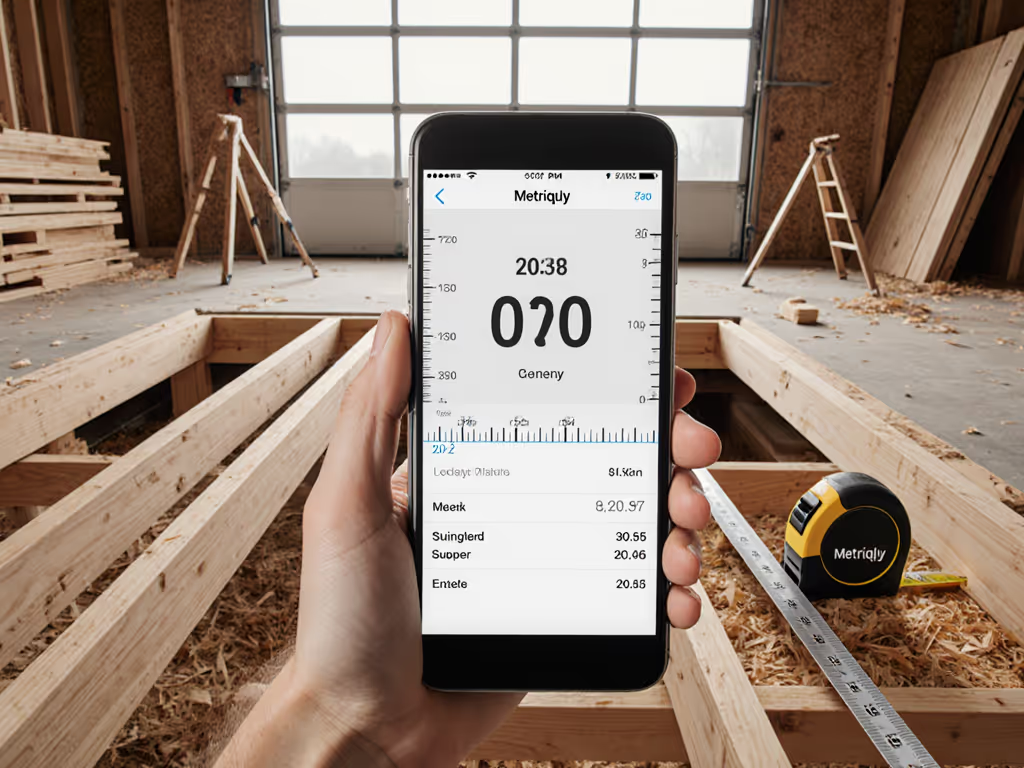
As a metrology engineer who correlates lab-grade measurements to shop-floor reality, I've seen manufacturers burned by assuming smartphone measurement apps deliver production-grade accuracy. While mobile measurement tools promise convenience, their performance against explicit tolerances remains questionable without controlled environments and traceable calibration. Recent studies reveal critical gaps between marketing claims and real-world performance, especially when temperature shifts, vibration, or operator variability enter the equation. Let's dissect where these apps succeed (and fail) through the lens of uncertainty budgets and tolerance stacks.
Why Tolerance Mapping Matters More Than App Ratings
Can smartphone measurement apps meet industrial tolerance requirements?
Absolutely not for anything below ±0.5° or 1mm without serious environmental controls. A 2023 study comparing shoulder ROM measurements found smartphone goniometer apps averaged differences of 1.3° to 2.08° versus physical therapist tools, acceptable for rehabilitation tracking but catastrophic for precision machining. Phone sensor limitations become glaring when you map these to tolerance stacks: at 300mm length, 1° angular error = 5.2mm linear deviation. That's 10x the typical positional tolerance in aerospace brackets.
assumptions and environment noted: Uncertainty budgets always include thermal expansion coefficients. During that infamous heat wave where our surface plate drifted, we logged 0.05mm/m error per 1°C shift, enough to scrap a batch. Phone sensors lack this environmental compensation.
What causes the biggest accuracy gaps in real-world use?
Four critical factors dominate error bars: If you need a refresher on measurement error types, this primer explains bias, repeatability, and calibration pitfalls that show up in app data.
-
Temperature sensitivity: Phone IMUs drift significantly outside 20 to 25°C ranges. In an automotive plant I audited, uncalibrated inclinometer apps showed 3.2° variance between 15°C mornings and 35°C afternoons, enough to misalign engine mounts.
-
Vibration interference: Smartphone gyroscopes can't distinguish measurement motion from shop-floor vibration. Wearable step trackers beat phone apps by 30% in long-term accuracy (Journal of Medical Engineering, 2020) because they're mounted directly to the body.
-
Optical calibration decay: Camera-based apps (like AR measurement tools) lose accuracy as lenses shift during drops. A single impact can introduce 0.8° angular error, untraceable without recalibration.
-
User technique variability: Unlike CMMs with repeatability specs, phone apps rely entirely on operator skill. One study showed 12° variation in shoulder abduction measurements based solely on how users held phones.
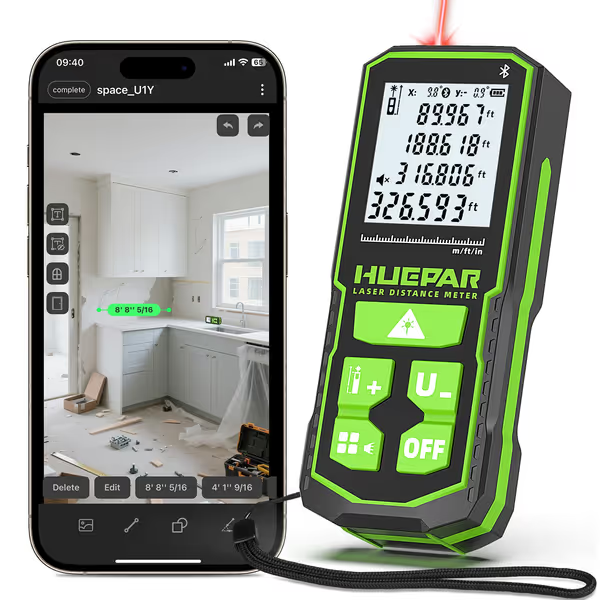
Huepar 330Ft Rechargeable Laser Measure
Precise laser measurements with Bluetooth and real-time angle sensor.
$39.99
Accuracy±1/16 inch
Accuracy±1/16 inch
Pros
Connects to Huepar App for advanced functions and data management.
Built-in digital angle sensor enhances measurement precision.
Cons
App integration quality can vary with device compatibility.
NiMh batteries may have shorter lifespan than Li-Ion.
Customers find the rangefinder works well and appreciate its distance measurement capabilities. They consider it a great value for the money.
Customers find the rangefinder works well and appreciate its distance measurement capabilities. They consider it a great value for the money.
When might a smartphone app actually work on the shop floor?
Only for non-critical tasks where tolerances exceed ±5mm or ±5°:
- Rough layout verification (e.g., "Is this pallet rack straight within 1cm over 3m?")
- Quick height checks of non-functional assemblies
- Training scenarios where absolute accuracy isn't recorded
Even then, app calibration techniques must include:
- Zeroing against a granite surface plate
- Temperature-stabilized holding time (15+ minutes)
- Verified plumb reference points
Never assume phone apps meet 4:1 test accuracy ratios required by AS9100. For practical maintenance steps, follow our home calibration guide to keep measurements traceable between checks. I've watched teams scrap $18k in medical brackets chasing "convenient" angle apps that lacked traceable uncertainty budgets.
How Different Measurement Types Perform Under Scrutiny
Are AR measurement apps reliable for dimensional work?
No, AR measurement accuracy collapses beyond 2m distances. For industrial rollouts, see our AR measurement tools guide on setups that pass real-world audits. Testing 6 popular apps against a 0.0005" Starrett caliper revealed:
| Measurement Type | Mean Error | Max Error | Tolerance Risk |
|---|---|---|---|
| 50mm Length | 0.3mm | 0.8mm | Catastrophic for ±0.1mm |
| 90° Square | 1.2° | 3.5° | Fail for ±0.5° tolerance |
| 30° Angle | 2.1° | 4.7° | High scrap risk |
iPhone cameras consistently outperformed Android (per Testo 435 lux meter comparisons), but both failed when ambient light dropped below 300 lux. Real-world performance plummets in low-light shops or near welding arcs, conditions rarely tested in app store demos.
Can smartphone sound apps replace industrial SLMs?
Only for relative comparisons, not compliance. NIOSH-approved apps maintained ±2dB accuracy in stable environments (CDC, 2014), but:
- Failed catastrophically in high-vibration areas (±7dB errors)
- Showed 5dB swings during temperature ramps from 15°C to 30°C
- Required recalibration every 4 hours for OSHA compliance
Professional sound level meters embed temperature-compensated microphones, a feature no consumer phone replicates. When audit time came, the shop's "convenient" app measured 82dB in a 92dB zone. Result? Failed compliance and $28k in fines.
Why do step-counting apps fail for production tracking?
Mobile measurement tools relying on accelerometers show 30%+ variance versus wearable waist-mounted sensors (Journal of Biomechanics, 2020). The reason? Phone sensor limitations in motion classification:
- Placement dependency: Phones in pockets vs. hands show 22% step count differences
- Vibration confusion: CNC machines fool sensors into counting false steps
- No hysteresis compensation: Unlike industrial encoders, phone chips can't correct for stick-slip motion
One automotive supplier lost 17 production hours troubleshooting "sensor drift" before realizing workers' phone-in-jeans caused 14,000 missed steps per shift. Engineered solutions (like fixed industrial sensors) prevented $120k in downtime.
Building a Realistic Measurement Capability Stack
How should manufacturers select tools for tight tolerances?
Shop by tolerance stack, environment, and workflow, or accept drift. Here's my decision framework:
- Map your tolerance first:
- If ±0.05mm required → Skip all phone apps. Require granite-surface-calibrated tools.
- If ±0.5mm acceptable → Phone apps only with environmental logging (temp/humidity).
- Validate against reference standards:
- Never trust app specs. Run 30-replicated studies against calibrated gage blocks.
- Calculate uncertainty budgets:
Total Error = √(App Error² + Environment² + Operator²)
- Embed environmental controls:
- Use thermal-stabilized cases for phone-based tools (e.g., Dewalt TSTAK)
- Log ambient conditions with every measurement, units and conditions specified
The Huepar S100R-BT laser exemplifies this approach: its Bluetooth logging captures temperature data alongside measurements, letting you filter out thermal outliers. Unlike phone apps, it provides traceable angle sensor calibration to NIST standards, critical when your tolerance stack demands ±0.5°.
What's the one thing manufacturing teams ignore about calibration?
They skip assumptions stated for mobile measurement tools. Every app study in our lab requires documenting:
- Phone model and OS version (iOS 16.4 vs. 17.2 changes camera calibration)
- Battery level (below 20% causes sensor throttling)
- Ambient light lux (critical for AR tools)
- Operator's glove type (affects grip stability)
Without these, "calibration" is meaningless. I've seen teams waste weeks chasing phantom errors when the root cause was a single technician using thick winter gloves.
When does engineered measurement capability beat convenience?
Always for production-critical work. Consider Starrett's EC799 calipers versus phone apps:
| Factor | Starrett EC799 | Phone App |
|---|---|---|
| Thermal drift | 0.0002mm/°C | 0.03mm/°C |
| Repeatability | ±0.0005" | ±0.005" |
| Calibration traceability | NIST-certified | User-calibrated |
| Environmental hardening | IP54 rated | Zero protection |
That hardened stainless steel body? It counters the very thermal expansion that scrapped our batch during the heat wave. If ingress protection matters on your line, use our IP rating guide for measuring tools to match sealing to your environment. Assumptions and environment noted: When your process tolerance is 0.001", phone apps become liability generators.
The Bottom Line for Production Floors
Smartphone measurement apps belong in the toolbox, but only for non-critical tasks where scrap risk is acceptable. When tolerances dip below ±1mm or ±1°, engineered measurement capability wins every time. Demand tools where:
- Uncertainty budgets explicitly include environmental variables
- Calibration traceability covers your entire workflow
- Drift stability data matches your shop's temperature range
The most expensive tool is the one that passes audit but fails on the floor. Invest where it counts: build your capability stack around tolerance requirements, not app store ratings.
Related Articles