
Vibration Measurement Comparison: Select Your Sensor
By Greta Lund • 15th Mar

Selecting the right vibration measurement technology means matching sensor type, frequency range, and output to your specific machinery, environment, and compliance requirements, not reaching for the latest platform and hoping it fits. In regulated manufacturing, a sensor mismatch doesn't fail silently; it produces data that looks legitimate but fails under audit scrutiny, triggers unnecessary maintenance actions, or misses real faults until they become catastrophic failures.
The Problem: Why Sensor Selection Matters More Than Convenience
Vibration monitoring has become central to predictive maintenance strategies across aerospace, medical device, automotive, and defense sectors. The appeal is straightforward: capture machine health trends, predict bearing wear, catch misalignment early, and reduce unplanned downtime. Yet the transition from manual route-based vibration surveys to continuous monitoring often exposes a hidden friction: the wrong sensor in a production environment doesn't just give imprecise data, it forces you to choose between incomplete evidence and expensive rework.
Consider the operational reality. You install sensors across a machining cell or assembly line, configure alarm thresholds, and begin collecting data. Weeks in, maintenance receives alerts but struggles to act because the sensor's frequency range misses the fault signature you actually need to detect. Or temperature swings in the plant shift baseline readings without warning. Or the wireless connectivity drops intermittently, and you have no way to know if silence means the machine is healthy or the data link failed. When an auditor arrives and asks for your measurement system validation (your uncertainty budget, your calibration records, your documented threshold rationale) you face a question that should have been answered during selection: Is this tool fit for purpose, or did we just spend money on hope? For building defensible documentation, use our measurement uncertainty budget guide to structure evidence your auditor will accept.
The core tension is that vibration sensors span an enormous range of capability, cost, and complexity. Piezoelectric accelerometers account for roughly 70% of industrial installations because they offer wide frequency response, high sensitivity, and rugged construction. But within that category alone, single-axis versus triaxial, 10 mV/g sensitivity versus 100 mV/g, wired output versus wireless, and each choice cascades into maintenance strategy, software integration, and audit readiness. Without a documented selection framework, you either overspend on capability you never use or underbuy and face inconsistent, unreliable data that breeds distrust in your entire condition-based maintenance program.
The Agitation: Where Selection Failures Surface
Frequency Mismatch and Missed Faults
Different machine faults produce vibration signatures in distinct frequency bands. Bearing-race defects typically appear at frequencies above 1,000 Hz; shaft misalignment shows up as strong harmonics of running speed (typically 2 to 500 Hz); looseness generates broadband turbulence across a wide spectrum. A sensor with a narrow frequency range (say, 0 to 2,000 Hz) will capture bearing faults but may miss the low-frequency signatures of foundation looseness or unbalance that don't exceed 60 Hz. If your maintenance plan assumes bearing-wear detection but your sensor can't reliably resolve bearing tones, you're documenting confidence you don't actually have.
Sensitivity and Environmental Drift
Accelerometer sensitivity is measured in millivolts per g of acceleration. The rule is straightforward: machines producing high-amplitude vibration (greater than 10 g RMS) need low sensitivity (10 mV/g) to avoid signal saturation; lighter machines need high sensitivity (100 mV/g) to resolve small changes. But sensitivity also interacts with temperature. Piezoelectric sensors are thermally stable relative to other designs, yet installations that fail to account for seasonal temperature swings or coolant-spray heating often see baseline drift that mimics machine degradation. Without documented acceptance criteria and seasonal filtering applied consistently, your October vibration trend looks like the machine aged three months in a week. To reduce bias and random error at the source, review our breakdown of measurement error types.
Integration Failure and Orphaned Data
Wireless vibration platforms promise seamless handoff to CMMS, ERP, or analytics software. In practice, data formatting, API stability, and firmware updates often create islands: the vibration system records rich condition data, but work-order generation, technician assignment, and root-cause documentation remain manual or siloed. The result is that engineers generate alerts, maintenance acknowledges them weeks late, and nobody has a single source of truth for what was monitored, when, or why. When you need to demonstrate for an ISO 9001 or AS9100 audit that your condition-based maintenance program is controlled and traceable, orphaned data is a compliance failure waiting to happen.
Undocumented Threshold Tuning
Many platforms encourage rapid threshold configuration: set an alarm at 2x baseline or a fixed frequency peak of 0.5 inches per second, and let the system run. The problem surfaces when thresholds trigger false alarms or miss early-stage faults, prompting operators or technicians to adjust them ad hoc. If it isn't documented, it's hope, not evidence under pressure. Auditors will ask: Who approved the threshold change? What data justified it? How do you know the new value is still fit for the machine? Without a controlled change process and traceability back to machine design or industry standards (ISO 20816-3 for rotating machinery, for example), you have guesswork masquerading as engineering.
The Solution: A Documented Framework for Sensor Selection
Step 1: Define Your Monitoring Intent and Acceptance Criteria
Before you buy a sensor, define in writing what you're trying to detect and what "acceptable" looks like for your machine. Are you hunting for bearing wear, shaft misalignment, looseness, or general machine degradation? Which faults will trigger immediate shutdown versus maintenance scheduling versus simple trending? This intent-setting exercise forces clarity and creates audit evidence. Document your acceptance criteria for each machine type:
- Fault type being monitored (e.g., bearing-race spalling)
- Expected vibration signature and frequency band (e.g., bearing fault frequencies, 2-5 kHz)
- Severity threshold (e.g., alert when peak exceeds ISO zone C limit for that machine class)
- Response protocol (e.g., stop machine immediately, schedule bearing replacement within 72 hours, collect follow-up data)
This framework (risk before convenience) ensures you select a sensor built for the job, not for general-purpose budget monitoring. A bearing-wear detection program on critical spindles needs triaxial accelerometers with frequency response to at least 5 kHz; a program to track overall asset runtime and catch gross anomalies may be satisfied by simpler, lower-cost broadband sensors. Both are defensible; guessing at sensor capability is not.
Step 2: Match Sensor Type and Specification to Machine Class
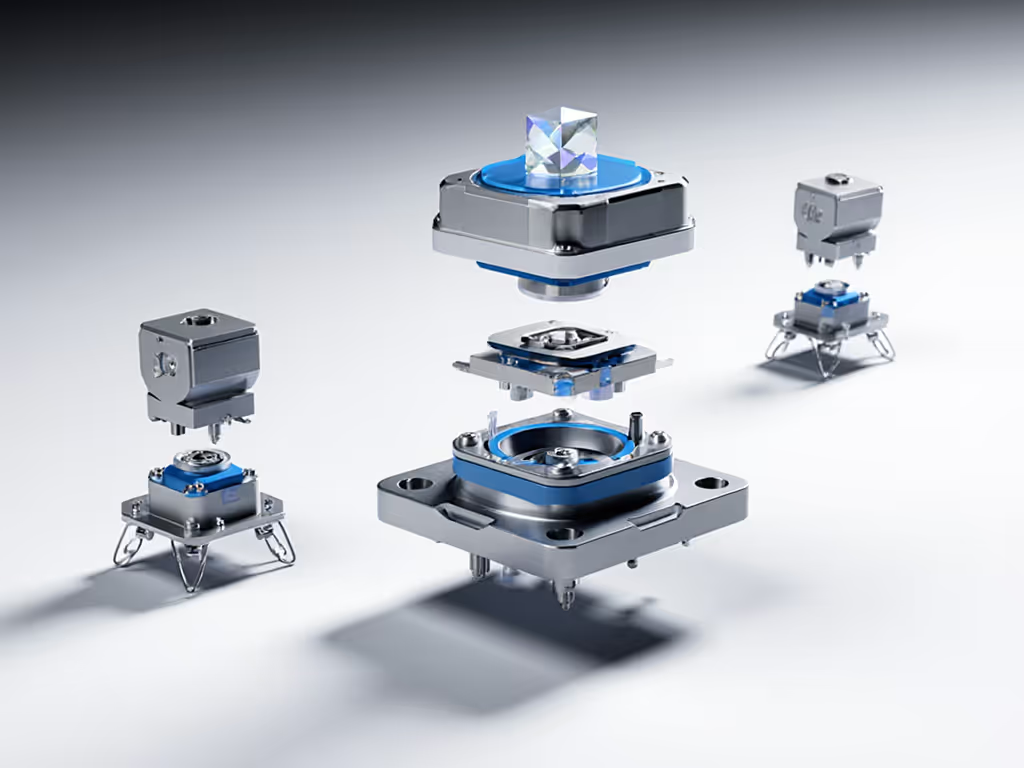
Industrial vibration sensors fall into three primary categories, each with distinct applications and trade-offs:
Piezoelectric Accelerometers These are the industry standard, used in approximately 70% of industrial installations. Strengths: wide frequency range (0.5 Hz to 10 kHz+), excellent sensitivity, robust against harsh environments (oil, dust, temperature extremes), no external power in charge mode. Weakness: can consume more power in integrated wireless systems and may require signal conditioning. Best for: bearing defect detection, machinery in harsh shop-floor environments, systems where ruggedness and proven reliability matter.
Velocity Sensors Measure vibration speed directly, offering lower sensitivity to high-frequency noise and reduced risk of amplifier overload compared to accelerometers. Frequency range typically 10 Hz to 2,000 Hz. Best for: general condition trending, rotor machinery, and facilities wanting simpler interpretation (velocity is often more intuitive than acceleration). Trade-off: less suitable for bearing-fault detection at the frequencies where early-stage spalling appears.
Proximity Probes Measure absolute position and vibration amplitude around rotating shafts; also provide rotor speed. Excellent for steady-state, high-amplitude machines like turbines and large motors, particularly for axial position monitoring. Less portable; requires proximity probe cables to power supply and transducer electronics. Best for: fixed installations where continuous rotor proximity is critical.
Your choice depends on your machine class, expected fault signatures, and your willingness to invest in conditioning electronics or wireless integration. Controlled language: Specify which type you've selected for each machine and why, in your monitoring plan. Include the part number, sensitivity range (mV/g), frequency response (Hz), and any environmental constraints (temperature range, IP rating, shock rating). This becomes your first evidence link to auditors.
Step 3: Define Measurement Output and Integration Pathway
Vibration data can be output as acceleration (g's), velocity (inches or mm per second), or displacement (mils or mm). Each tells you something different and integrates differently into your CMMS or analytics system. Clarify:
- Which output form your maintenance team will interpret and act on (e.g., velocity trends in ISO bands 2-5 kHz for bearing diagnostics)
- Whether you need integrated temperature measurement to account for seasonal drift
- Whether you need triaxial (three-axis) or single-axis measurement (triaxial is richer but more complex to interpret and integrate)
- How data will flow from sensor to decision point: wireless upload, cloud storage, local gateway, manual download
Document the end-to-end pathway: sensor → data protocol (e.g., Wi-Fi, cellular, WirelessHART) → storage → analysis software → maintenance action. If wireless hardware is central to your plan, see our wireless measurement tools for SPC integration to avoid data silos. If any step in that pathway is manual or undocumented, you have a control gap. If it is automated, validate that the pathway has been tested, that firmware versions are tracked, and that data integrity is verified (e.g., no missing records, no corruption during transfer). For architecture decisions, compare edge vs cloud metrology to balance latency, security, and cost.
Step 4: Establish Threshold Rationale and Revision Control
A vibration alert threshold must rest on evidence, not convenience. For each monitored machine, document:
- Baseline condition (amplitude and frequency content during known-good operation, ideally after commissioning)
- Alarm threshold and justification (e.g., ISO 20816-3 zone transition, bearing fault frequencies, manufacturer recommendation, or historical failure data from identical machines)
- Alert response protocol (immediate notification, scheduled maintenance, investigation, or trending only)
- Revision history (date threshold was set, who approved it, why, and approval signature)
This is where risk-based thinking intersects with documentation. If you change a threshold because you've seen fewer false alarms at a higher level or you want to catch degradation earlier, that change must be controlled like any other quality procedure. Without revision control, thresholds drift, and your system loses its audit trail. With it, you can demonstrate that every alarm decision point in your program has been engineered, not guessed.
Step 5: Validate Your System Before Production Deployment
Before you deploy vibration sensors across your facility, run a validation pilot on one representative machine or machine type. Collect at least two weeks of baseline data under normal operating conditions. Verify:
- Data is captured consistently (no dropouts or gaps)
- Frequency resolution is adequate to detect the faults you're hunting for
- Temperature swings in your facility don't induce spurious baseline drift
- Wireless signal quality is reliable at mounting locations
- Software alerts trigger at the thresholds you specified, with no false positives during this trial period
- Data integrates correctly into your CMMS or SPC tool
- Technicians can interpret the alerts and take documented action
Document this validation as a measurement system analysis (MSA) or system qualification report. Include representative data plots, baseline averages, and a sign-off confirming the system is fit for production use. This document becomes your evidence that vibration monitoring is not ad hoc but engineered and controlled.
Vendor Evaluation and Wireless Integration
If you're considering wireless vibration platforms, compare not just sensor sensitivity and frequency range, but also:
- Analyst support and diagnostic depth: Some platforms offer raw data and threshold management only; others include pattern recognition and bearing-fault algorithms trained on failure databases. Understand what you're buying and what work remains on your side.
- Range and reliability in your environment: Wireless systems must perform in the presence of shop-floor noise, coolant spray, and metal structures. Pilot testing in your actual facility is non-negotiable.
- Data export and integration: Can you export raw time-waveform data for offline analysis? Can the system integrate with your existing CMMS via API or CSV? Are firmware updates managed transparently, or do they change sensor calibration unexpectedly?
- Calibration and traceability: Ask the vendor for proof that sensors have been calibrated to a traceable standard (NIST, national metrology institute equivalent) and that calibration certificates are issued with each unit. If they're not, you don't have metrological evidence; you have an unvalidated system.
Beyond Sensor Selection: The Bigger Picture
Selecting a vibration sensor is not an isolated purchase decision; it's the anchor for your condition-based maintenance program. The sensor must integrate into a documented workflow: baseline establishment, threshold justification, alert response, root-cause investigation, and corrective action. Systems designed specifically for industrial use consistently outperform general-purpose monitoring tools because they address sensing, diagnostics, and execution as one unified workflow. But even the best platform is only as reliable as the discipline you bring to threshold control, data integrity, and team training.
Technicians must be trained on correct mounting (cosine error and Abbe effect are real), proper probe force for portable measurements, and how to interpret frequency spectra. Your CMMS must enforce that every work order triggered by a vibration alert includes a link to the baseline data, the fault hypothesis, and the corrective action taken. Your audit schedule must include a review of vibration program effectiveness: Are alerts leading to repairs? Are repairs preventing failures? Or is the system generating noise that training and tighter thresholds can quiet?
When an auditor arrives, your evidence should be immediate and traceable: sensor certificates with calibration dates, documented thresholds with approval signatures, baseline reports, fault investigations linked to maintenance records, and a sample of alert-to-work-order decisions demonstrating that your predictive maintenance sensors are not decorative but operational and controlled. That confidence, that your measurement system will survive scrutiny and earn trust on the floor, is what vibration measurement technology comparison aimed at standards-driven integrity actually delivers.
The path forward is clear: define your intent in writing, match sensor type to machine class and fault signatures, document thresholds with traceability, validate before production, and integrate into a controlled workflow. Consistency and documentation convert good measurements into reliable decisions. Everything else is just noise.
Ready to build a vibration program your audit team will recognize as engineered and controlled? Start by mapping your critical machines, their failure modes, and the vibration signatures you need to detect. Document your baseline during known-good operation, set thresholds with traceability, and pilot your system on one representative asset. That discipline (risk before convenience) turns a vibration platform from a nice-to-have into a competitive edge and audit-proof asset.
Related Articles