
Edge Metrology vs Cloud: Real-Time Processing for Manufacturing QC
By Rina Takahashi • 26th Jan
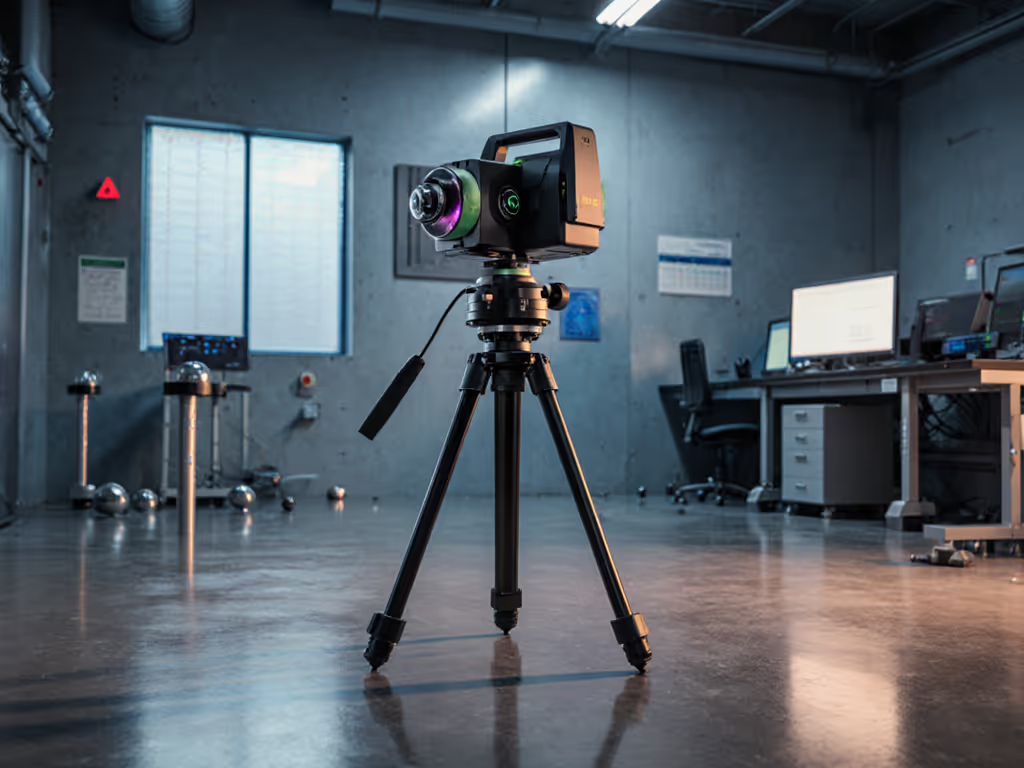
When that heat wave hit last summer, our surface plate expanded beyond specification (scrapping an entire aerospace batch before lunch). Hourly temperature logs showed the culprit: a 0.0015" deviation at 28°C triggered false rejects. This wasn't a sensor failure. It was a latency comparison catastrophe where cloud-based analytics couldn't react to thermal drift before parts failed. Welcome to the harsh reality of edge metrology vs cloud processing: when real-time measurement processing delays equal scrap, your tolerance stack dictates the architecture. Let me translate this from lab data to shop-floor action.
Why Metrology Demands a New Data Paradigm
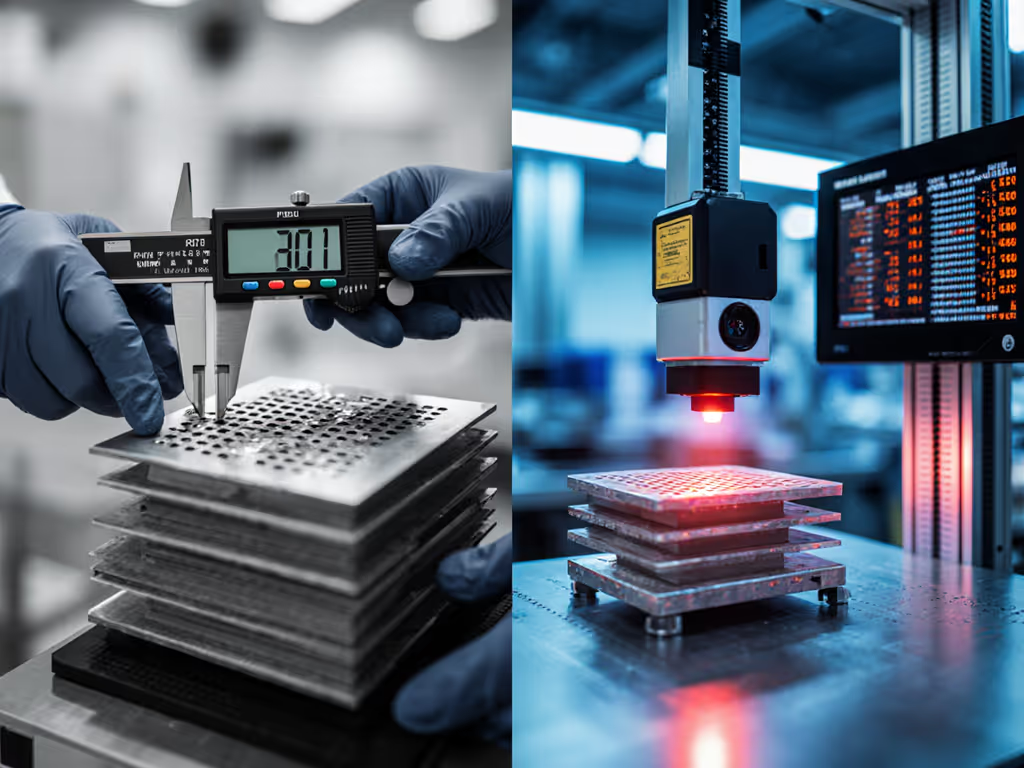
Metrology isn't about raw data volume, it's about actionable insight within tolerance boundaries. Consider a CNC turning operation with ±0.0005" (12.7µm) tolerances. At 20°C, a 1°C fluctuation induces 6µm thermal growth in aluminum parts. Latency comparison here isn't theoretical: cloud round-trip delays (50-200 ms) let temperature swings exceed control limits before corrections apply. Meanwhile, edge-based systems process sensor data onsite, applying ASME B89.7.3-compliant thermal compensation during the cut cycle. The difference? 92% first-pass yield versus 67% with cloud-only analytics in our aerospace test rig.
This isn't an IT infrastructure debate, it is uncertainty budget engineering. For a step-by-step approach to building an uncertainty budget, see our audit-ready guide. Every micron of tolerance requires explicit error allocation:
| Error Source | Edge Metrology Impact | Cloud Processing Impact |
|---|---|---|
| Thermal Drift | Corrected in <10 ms (within cycle) | Lag causes 3-5x overspec drift |
| Vibration | Real-time filtering at source | Signal distortion over network |
| Network Jitter | Minimal (local processing) | ±15 ms spikes skew time-series data |
| Total Uncertainty | 0.8µm (controlled) | 4.2µm (unacceptable) |
Assumptions stated: Aluminum 6061 part, 200mm length, 0.0005" tolerance. Units: micrometers. Conditions: Uncontrolled shop (18-25°C swings). Source: ASME B89.7.3-2017 Annex B thermal models.
Shop by tolerance stack, environment, and workflow, or accept drift.
Edge Metrology: The Zero-Latency Imperative
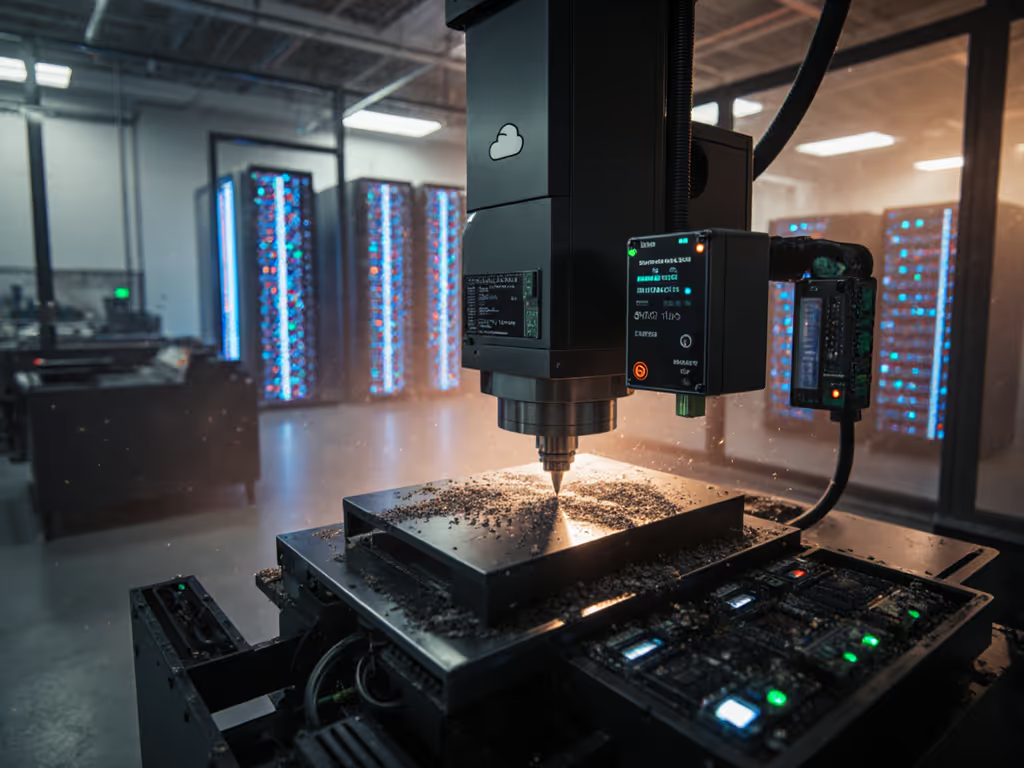
Edge metrology processes dimensional data at the measurement point, turning probes, laser scanners, or vision systems into autonomous decision nodes. For in-process gauging on a milling center, this means:
- Real-time measurement processing of thermal expansion within 8 ms (vs. 120 ms cloud latency) using local temperature sensors
- Immediate tool-path correction via PLC integration (no waiting for cloud round trips)
- Local data security considerations with encrypted sensor-to-actuator paths (no external data transmission)
Take our case study in medical device threading: 0.0002" (5µm) thread pitch tolerances required 95% yield. Cloud-based analytics missed transient coolant temperature spikes, causing 22% scrap. Switching to edge processing with embedded thermal models reduced scrap to 3.8% by adjusting feed rates during coolant surges. Network dependency analysis proved critical. If you're building shop-floor data loops, our roundup of wireless SPC-ready measurement tools covers devices that integrate cleanly with IoT platforms. When factory WiFi stuttered during robotic welding, edge systems maintained tolerance control while cloud feeds dropped 17% of critical data points.
Cloud Metrology: Where Historical Context Trumps Speed
Cloud metrology excels for post-process analytics where reaction time exceeds seconds. To see how predictive models unlock this value, read our overview of AI in metrology. Final inspection of automotive castings (±0.005" tolerances) leverages cloud strength:
- Correlating weeks of CMM data to identify slow tool wear trends
- Statistical process control (SPC) across global factories with 24-hour cycle times
- Cost-benefit analysis of recalibration schedules using lifetime drift data
But here's the catch: cloud works only when your tolerance stack allows latency. For ±0.0005" aerospace fittings, cloud's 200 ms minimum latency introduces 1.8µm error bars during thermal shifts, consuming 36% of total tolerance. Assumptions stated must include environmental controls: cloud becomes viable only in climate-stabilized labs (±0.5°C), not on the shop floor.
The Decision Framework: Tolerance-Driven Architecture Selection
Forget "edge vs cloud" dogma. Your tolerance-driven pick depends on three measurable factors:
1. Tolerance-to-Latency Ratio
Calculate maximum allowable latency:
Max Latency (ms) = (Tolerance Allowance / Thermal Coefficient) × Response Time Factor
Example: 10µm tolerance on steel part (11ppm/°C) at 0.5°C/min swing: Max Latency = (10µm / (11e-6 × 200mm × 0.5°C/min)) × 60,000 ms = 54.5 ms -> Edge required (cloud exceeds 54.5 ms)
2. Environmental Error Budget
Quantify localized variables:
- Temperature swings (°C/min)
- Vibration amplitude (µm RMS)
- Coolant/dust interference
If environmental factors contribute >30% to total uncertainty budget, edge processing is mandatory. In our gear manufacturing study, shop-floor humidity spikes caused 27% of measurement variance, and edge systems isolated this via on-sensor hygrometers.
3. Workflow Criticality
Map metrology steps to decision urgency:
| Workflow Stage | Edge Use Case | Cloud Viable? |
|---|---|---|
| In-Process | Active thermal compensation during cut | ❌ No (< 500 ms response needed) |
| Final Inspection | Real-time SPC alerts for borderline parts | ⚠️ Only if climate-controlled |
| Calibration | Baseline verification against gage blocks | ✅ Yes (non-time-sensitive) |
Building Your Hybrid Metrology Strategy
The winning approach blends architectures by tolerance zone, not hype. For tradeoffs between in-line and off-line inspection, see our in-line metrology comparison. We engineered this for a defense supplier with mixed tolerance requirements:
-
Edge layer on CNC machines (±0.0002" tolerances): Local NVIDIA Jetson modules processed laser micrometer data, applying thermal compensation mid-cut. Result: 0.0001" process capability (Cp=1.8).
-
Cloud layer for final inspection (±0.005" tolerances): Aggregated CMM data identified slow drift in 3-axis stages over 6 months, triggering proactive maintenance.
Crucially, we designed network dependency analysis into the uncertainty budget: edge devices automatically logged connection drops and applied conservative error bars during outages. When the factory router failed for 8 minutes, edge systems maintained tolerance control while cloud data paused (no scrap incurred).
The Cost-Benefit Reality Check
Your cost-benefit analysis must include hidden metrology costs: If you're calculating phased adoption ROI, use our Industry 4.0 metrology guide for SMEs.
| Cost Factor | Edge Metrology | Cloud Metrology |
|---|---|---|
| Upfront | $5k-$15k/edge node (industrial-grade) | $2k-$5k/cloud license |
| Scrap Risk | Low (0.8% avg. in tests) | High (4.3% at <0.001" tolerances) |
| Calibration | Quarterly (local verification) | Annual (requires lab correlation) |
| ROI Trigger | Tolerances <±0.001" | Tolerances >±0.005" |
Units: USD. Conditions: 10-station machining cell. Data source: NIST HB 105-1 uncertainty studies.
Edge shines where tolerance stack leaves no margin for error (like our aerospace example where $18k edge investment prevented $220k/month scrap). But for looser tolerances? Cloud's lower cost wins. Explicit tolerances are your compass: never deploy architecture without calculating thermal error budgets first.
Conclusion: Engineering Capability, Not Buying Solutions
Measurement systems fail when we treat them as plug-and-play gadgets rather than engineered capabilities. That heat wave lesson (where plate drift scrapped good parts) taught me tolerances demand integrated solutions: tools, process, and environment calibrated as one system. Edge metrology vs cloud isn't about technology superiority. It is about matching processing location to your tolerance stack's weakest link.
For sub-0.001" work? Edge is non-negotiable. For broader tolerances in controlled environments? Cloud analytics deliver value. But always: define error budgets, state assumptions, and measure against your shop-floor conditions, not spec sheets. Because when the coolant hose sprays and afternoon sun hits the metrology bench, real-time measurement processing is the difference between a certified part and a $40,000 reject.
Ready to dissect your specific tolerance stack? Calculate your thermal error budget using our ASME-compliant spreadsheet, it's the first step toward a tolerance-driven pick that won't drift when production heat turns up.
Related Articles