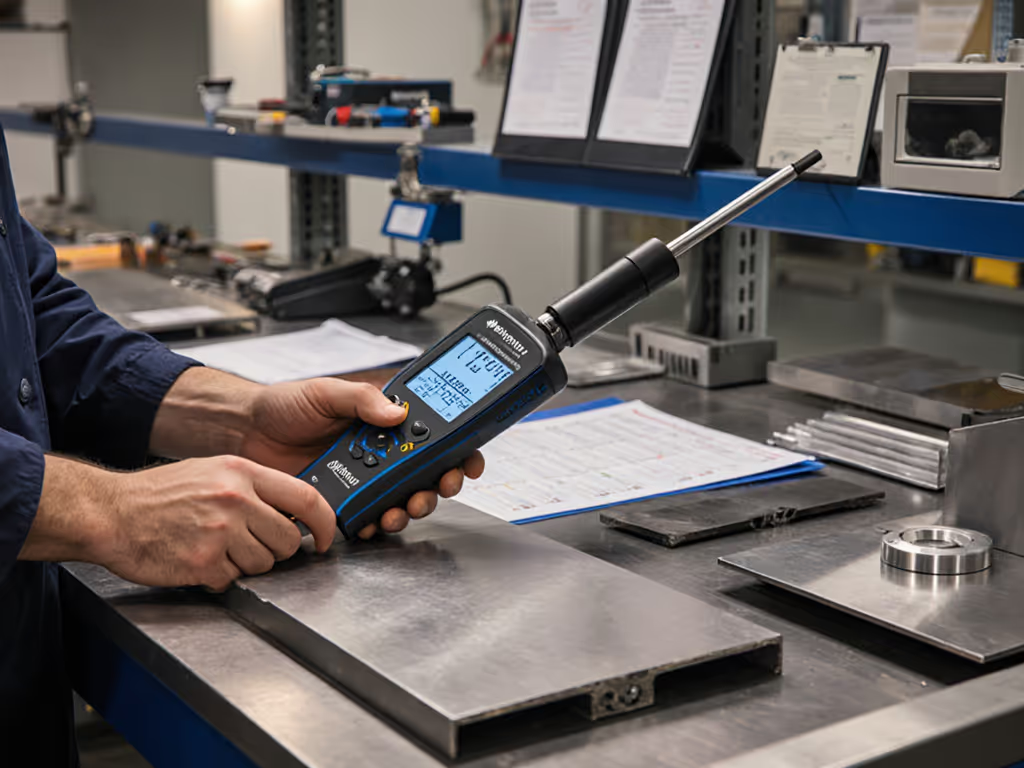
Optical Comparator vs Vision System: Accuracy That Lasts
By Alejandro Ruiz • 28th Oct
When your audit hinges on traceable measurements and a single day of downtime bankrupts your quarterly profit, the optical comparator vs vision system decision isn't about specs, it's about survival. I've watched too many shops buy on initial price, only to bleed six-figure losses from calibration drift and unavailable spares. True precision vision measurement means capability sustained through coolant splashes, shift changes, and three-year audit cycles. If your cameras or stages will see coolant or dust, review our guide to IP ratings for harsh environments. That's why I run vendor trials with the same TCO math that got us out of the $47k downtime trap last year. Pay for capability, not chrome, and count the lifecycle costs.
How Measurement Philosophy Defines Real-World Reliability
Optical comparators and vision systems share the goal of dimensional verification, but their core approaches create vastly different operational realities. Let's dissect what actually matters on your shop floor:
Optical Comparator
- Mechanism: Projects a magnified silhouette using collimated light (often LED now) against a glass scale. Operators manually align crosshairs with the part's shadow.
- Strengths: Unmatched speed for simple 2D measurements like thread pitch or radii. Minimal training curve (your veteran machinist can run it by lunchtime).
- Reality Check: Profile projection accuracy crumbles with complex geometries. As one aerospace supplier learned, measuring a turbine blade's fillet radius requires multiple rotations under the light source. Each repositioning introduces alignment error that compounds with operator fatigue. And when ambient light fluctuates mid-shift? Your ±0.0002" accuracy spec vanishes.
Vision Measurement System (VMM)
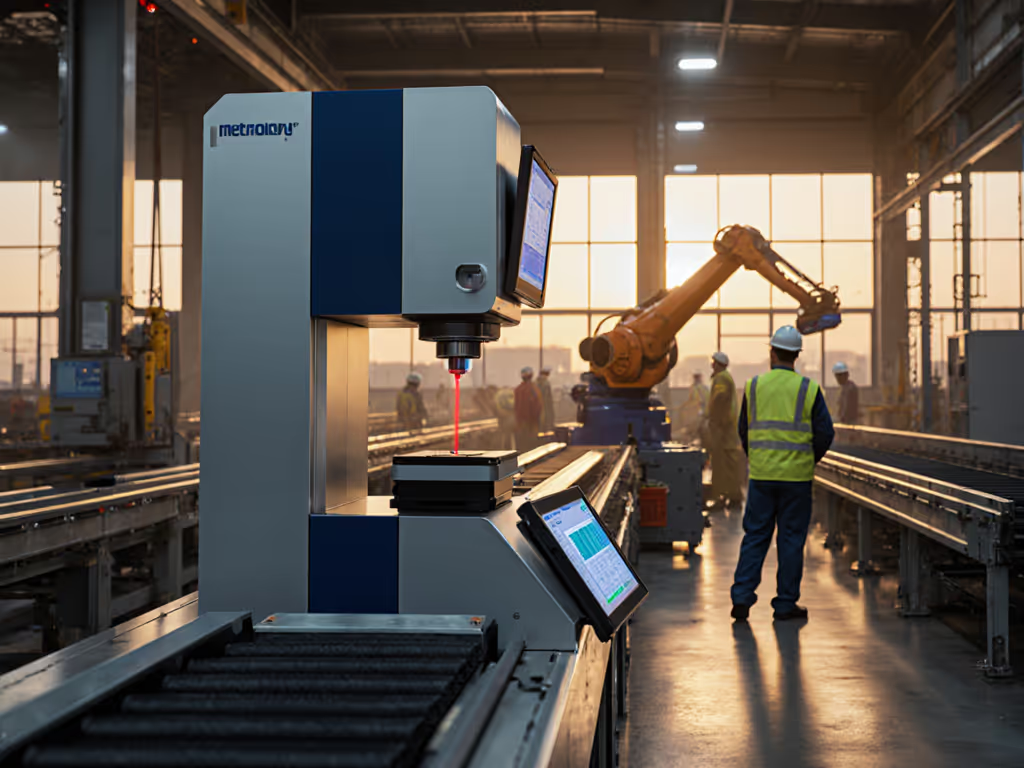
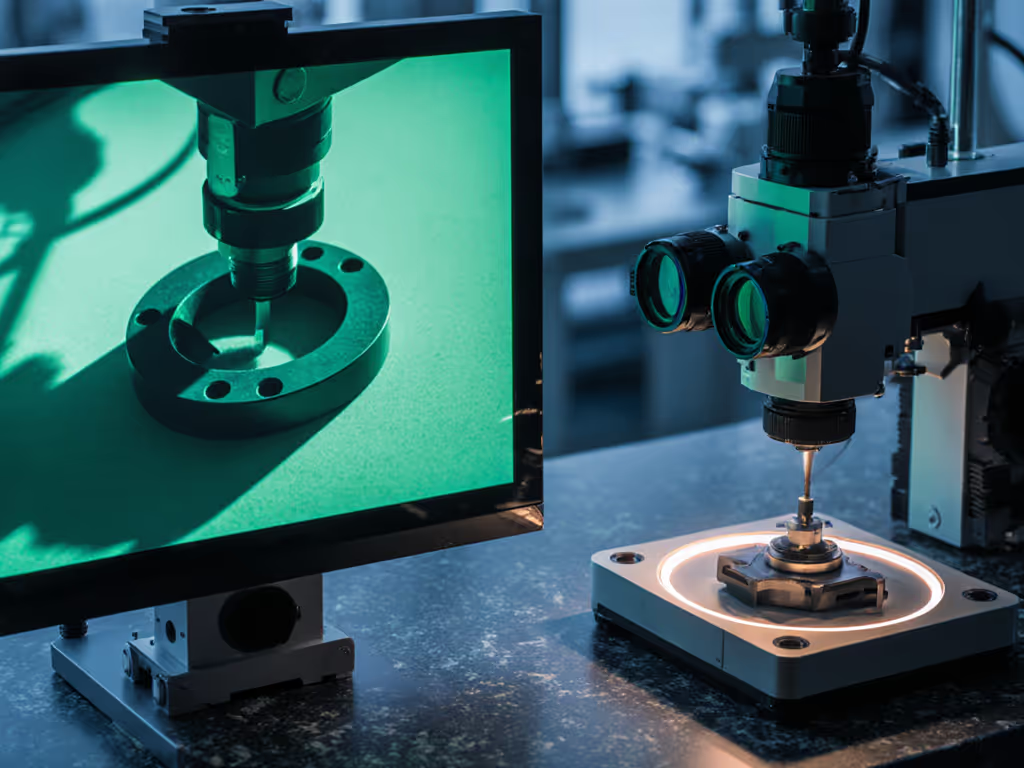
- Mechanism: Uses digital cameras, multi-axis stages, and edge detection algorithms to capture 2D/3D data points. Modern systems integrate laser or touch probes for multisensor capability. If you're evaluating other non-contact options, compare non-contact metrology to choose the right technology.
- Strengths: Edge detection technology eliminates human interpretation. A medical device manufacturer reduced measurement variation by 78% after switching from optical to vision for catheter hubs (critical when tolerances hit ±0.0005").
- Reality Check: Poorly configured systems create false confidence. I've audited 'high-precision' VMMs where vibration from nearby CNC machines skewed results by 0.003". Software matters as much as optics, and some vendors charge $15k for basic GD&T reporting.

The Hidden Cost Killers Your Spec Sheet Won't Show
Manufacturers fixate on resolution numbers while ignoring the operational tripwires that derail production. My TCO math models always include these five silent profit killers:
-
Downtime risk from calibration drift Optical comparators drift faster under shop-floor conditions. A study by NIST found 62% of manual comparators exceeded calibration tolerance within 90 days when exposed to typical factory temperature swings (65°-80°F). VMMs with thermal compensation algorithms maintain stability 3x longer, but only if the service contract includes quarterly recalibration. I've seen vendors advertise '5-year accuracy' while excluding recalibration costs that run $1,200/year.
-
Spares lists that don't cover reality When a bargain vision system's encoder failed at Prestige Components, we waited 17 days for a $389 replacement stage. The supplier's 'comprehensive spares list' omitted that critical component. Optical comparators suffer similarly, a burned-out bulb in a legacy comparator can halt production for weeks if it's discontinued. Always demand the actual lead time for stage assemblies, not just bulbs or lenses.
-
Training gaps disguised as 'ease of use' Optical comparators get praised for simplicity, but improper edge lighting causes cosine error that invalidates measurements. I tested a supposedly 'operator-proof' comparator: 3 out of 5 technicians misread chamfer angles by 0.0015" due to inconsistent shadow contrast. VMMs require software training, but build repeatable protocols that survive shift changes.
-
Data traceability black holes Audit failures spike when measurement systems can't output SPC-ready data. Optical comparators typically provide only pass/fail results, meaning your ISO 9001 audit lacks dimensional trend analysis. Vision systems generate full reports, but proprietary software often blocks integration with Quality Management Systems. Demand API access in your purchase agreement. For real-time SPC, consider wireless SPC tools that integrate with IoT platforms.
-
The standardization tax Purchasing different tools per department seems efficient until you're managing three calibration schedules and incompatible fixturing. I helped a medical device firm consolidate to one VMM platform across 7 sites, cutting calibration costs 34% and eliminating $210k in annual scrap from inconsistent methods. Standardize where it helps, especially on software interfaces and probe types.
When to Choose Which: A Tolerance-Driven Decision Framework
Stop comparing marketing brochures. Match the tool to your tightest tolerance stack, not the 'hardest' measurement:
| Criterion | Optical Comparator Wins When | Vision System Wins When |
|---|---|---|
| Tolerance | ≥0.001" (25µm) | <0.001" (25µm) |
| Part Complexity | Simple 2D profiles (gears, threads) | 3D features, blind holes, curved surfaces |
| Throughput | High-volume simple checks (100+ parts/hr) | Mixed batches with complex GD&T |
| Audit Requirements | Basic dimensional checks | Full traceability with SPC data |
| Environment | Dirty shop floors (no camera vulnerability) | Controlled labs or clean production cells |
Critical threshold: If your process capability (Cp) must exceed 1.33, vision systems dominate. At Precision Gearworks, switching to VMMs for 0.0008"-tolerance splines boosted first-pass yield from 76% to 98%, paying back the $82k investment in 5 months through scrap reduction.
The Service Strategy That Makes or Breaks Your ROI
Hardware is just the entry ticket. Your real protection lives in service terms:
-
The 24-hour rule: If a stage failure halts production, your vendor must deliver loaners within 24 hours. I've cancelled contracts with 'global leaders' for 72-hour response promises. One medical manufacturer saved $380k in downtime by insisting on this clause.
-
Calibration transparency: Demand the actual uncertainty budget for your measurement range, not lab-perfect specs. A reputable vendor will provide a full MSA report before purchase.
-
Spares commitment: Verify availability for critical components through a 5-year horizon. I've seen 'discontinued' optical comparators become scrap when bulb suppliers vanished.
This is where my early vision probe disaster paid dividends. When a stage failed last year, our vendor's pre-validated loaner arrived at 6 AM, and production never stopped. That's the downtime risk mitigation you actually pay for.
Pay for capability, not chrome, and count the lifecycle costs
Making Your Move: Action Steps That Deliver Confidence
Don't gamble on walkthrough demos. Implement these before writing a PO:
-
Run a tolerance stress test: Provide your vendor with a part at your tightest tolerance limit. Require measurement of 30 consecutive pieces with GR&R analysis. If they refuse, walk away.
-
Demand the full spares list: Not the brochure version, ask for lead times on stage assemblies, encoder boards, and light sources. Cross-reference with independent suppliers to verify availability.
-
Lock in service terms: Require 12-hour critical issue response in writing. Negotiate flat-rate calibration pricing to avoid annual cost spikes.
-
Validate integration: Test data export to your QMS. If the vendor says 'it should work,' they've never done it.
When a defense contractor faced AS9100 audit failure due to inconsistent measurements, we implemented this exact protocol. They selected a vision system not for its 5MP camera, but because the vendor guaranteed 4-hour onsite support for critical failures. Eighteen months later, zero downtime incidents.
The Bottom Line: Accuracy That Endures
Your measurement tool isn't a purchase, it's a production insurance policy. Optical comparators still earn their place for simple 2D work where $0.001" variance won't sink a job. But when tolerances tighten, regulations bite, or downtime could shutter you, vision systems deliver capability that lasts through real-world wear. Cut through the 'accuracy' hype and run the TCO math with all hidden costs: calibration reality, spares vulnerability, and service speed. Because the true cost isn't what you pay upfront, it's what you lose when the machine stops and the parts pile up. Standardize where it helps, but never standardize on fragility.
Related Articles