Measurement Traceability Basics: Why It Matters
By Greta Lund • 8th Apr

Metrology traceability basics establish the foundation for every measurement decision in regulated manufacturing. Measurement traceability is simple in principle: it is the documented ability to link any measurement result back through an unbroken chain of calibrations to recognized national or international standards, with each step characterized by its measurement uncertainty [7][8]. For a deeper foundation, read our traceability overview.
The stakes are concrete. Without it, you have data, not evidence.
FAQ: Understanding Measurement Traceability
What Exactly Is Measurement Traceability?
Measurement traceability refers to the property of a measurement result whereby it can be related to stated references (typically national or international standards) through an unbroken chain of comparisons, all documented with their associated uncertainties [7]. Think of it as a genealogy for your measurement: each calibration is a documented step back toward a recognized authority, usually the National Institute of Standards and Technology (NIST) for North American work [2].
Traceability is not optional precision theater. It is a structural requirement. Each link in the chain (primary reference standards, secondary reference instruments, and working standards used during calibration) must be documented and characterized [8]. This documentation itself becomes evidence.
How Does Traceability Differ from Accuracy or Repeatability?
Three related but distinct concepts often blur together on the shop floor:
- Accuracy describes how close a measurement is to the true value. Accuracy alone tells you nothing about why the reading is reliable or how you know it aligns with a standard.
- Repeatability (or precision) is how consistently the same instrument produces the same reading under the same conditions. A worn caliper might repeat perfectly (wrong, but consistently).
- Traceability links both accuracy and repeatability back to a defined reference, with documented uncertainty. It answers the audit question: "On what authority does this number stand?"
Traceability is the chain; accuracy and repeatability are qualities of the links [2][3]. If you want a quick refresher, see accuracy vs precision with real-world examples. Consistency and documentation convert good measurements into reliable decisions, and that conversion only works if the chain exists and is documented.
Why Should a Shop Floor Care About SI Unit Traceability?
SI unit traceability ensures that your 50.0 mm reading in your shop means the same thing as a 50.0 mm reading in a lab in Germany or a supplier in Japan [2]. The International System of Units (SI) is that common language [5]. When your digital micrometer is traceable to SI standards through NIST, you are buying into global comparability and regulatory credibility.
In practice, SI traceability matters because it enables:
- Cross-site consistency: a part measured as "in tolerance" at your facility will be in tolerance at your customer's receiving dock [6].
- Regulatory alignment: ISO 9001, ISO/IEC 17025, AS9100, IATF 16949, and FDA frameworks all require documented traceability to SI or recognized national standards [2][3]. For labs pursuing accreditation, our ISO/IEC 17025 guide breaks down the requirements and documentation.
- Defensibility: during an audit, when asked "How do you know this measurement is accurate?", traceability is the answer that stands up.
Conversely, if your calibration certificate traces only to an internal standard with no documented link to SI or NIST, you are dependent on hope, not evidence under pressure.
What Are the Calibration Chain Fundamentals?
Calibration chain fundamentals rest on a pyramid structure [8]:
- Primary Reference Standards - maintained by national authorities (NIST, NPL, PTB, etc.). These are the top of the chain and rarely leave a laboratory.
- Secondary Reference Instruments - higher-accuracy standards used to calibrate working tools. These remain in controlled environments and are calibrated periodically against primary standards.
- Working Standards and Field Instruments - the calipers, micrometers, bore gages, and gauges used in production. These are calibrated against secondary standards.
Each step is documented with uncertainty statements. Build yours using our measurement uncertainty budget guide with audit-ready steps. This hierarchy is not pedantic: it is risk engineering. A working gauge calibrated against a primary standard (skipping secondary) introduces uncertainty and breaks the defensible chain.
Why does this matter? During a customer PPAP audit or a regulatory inspection, an inspector will ask for your calibration certificate. That certificate should show an unbroken chain back to a recognized standard, with measurement uncertainties stated at each step [6]. If there is a gap (a revision missing, a standard undocumented, an interval expired), the entire chain is compromised. I once witnessed a micrometer used on a critical aerospace part fail supplier approval because the calibration certificate showed the reference standard itself lacked current traceability. We rebuilt the control protocol with explicit revision tracking on every SOP and retrained operators on version control. The next audit took twelve minutes on that station (no delays, no rework questions, just documented evidence).
How Do Practical Traceability Examples Reduce Risk?
Practical traceability examples illustrate why this structure survives audits:
-
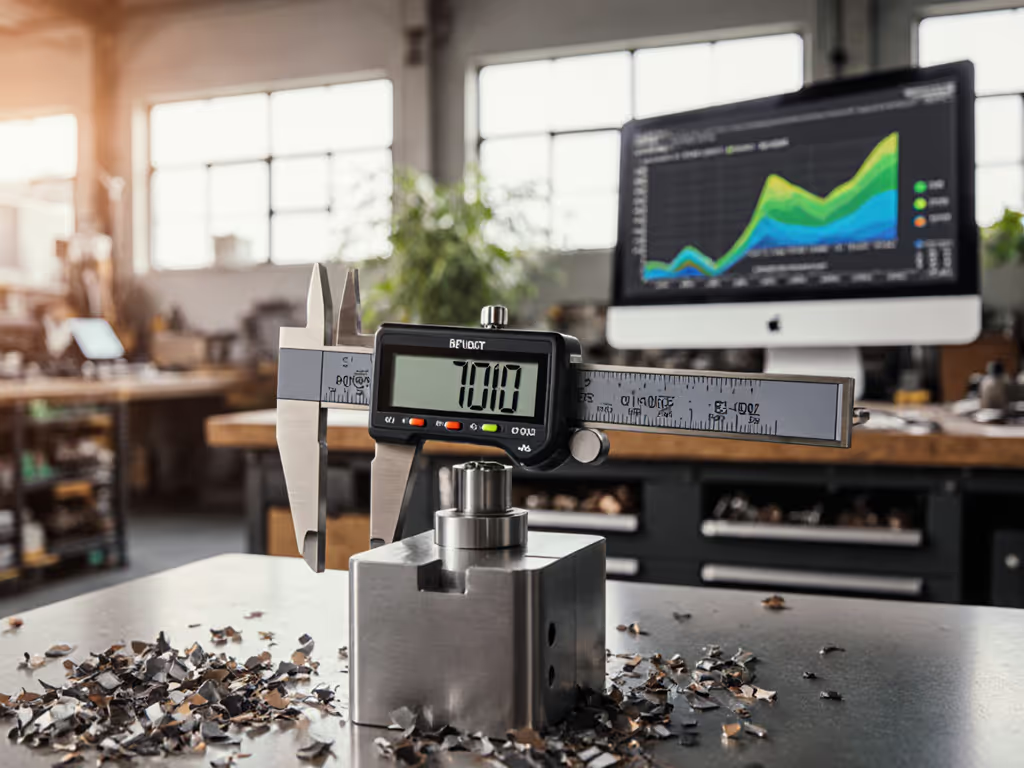
Example 1: In-Process Turning Cell - A CNC lathe uses a calibrated micrometer to verify bore diameter mid-run. That micrometer is traceable to NIST via a calibration certificate issued by an ISO/IEC 17025 accredited lab within the last 12 months. The operator logs the reading into the SPC system. If a trend emerges, you know the tool or process is drifting, not the measurement system. Risk is isolated and decisions are evidence-based.
-
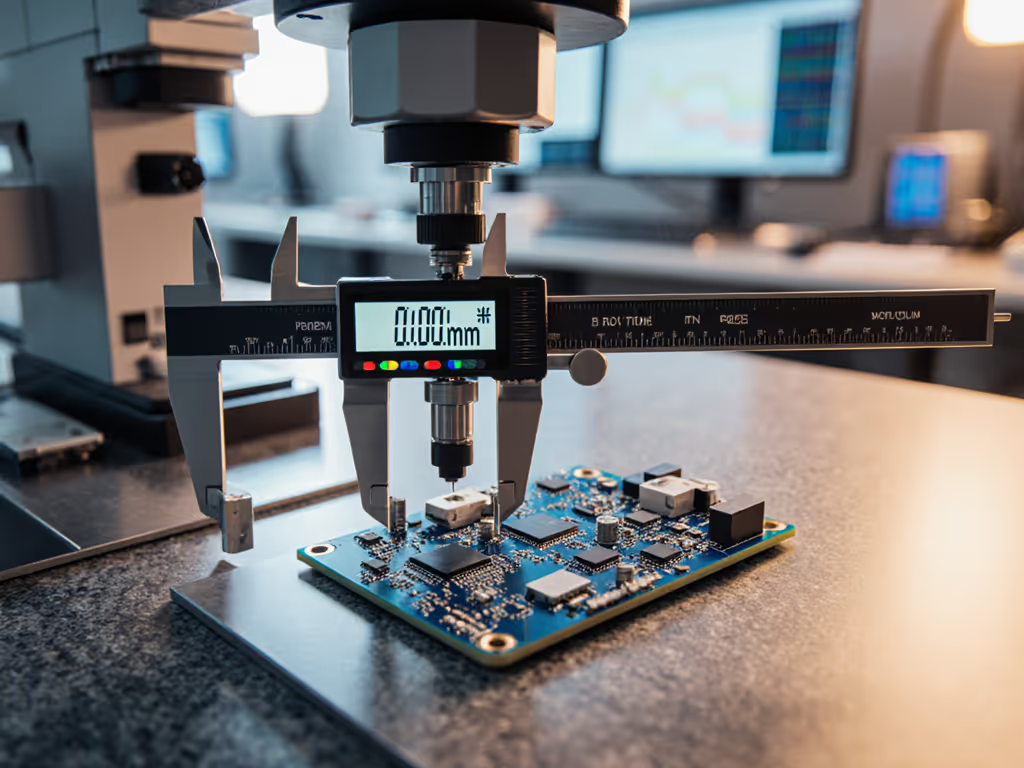
Example 2: Final Inspection of Medical Device - A coordinate measuring machine (CMM) is used to verify critical surfaces. Its traceability chain includes documented gage block calibration, probe qualification, and thermal compensation. If your product passes CMM inspection, your customer can audit your traceability chain.
Related Articles