Sports Science Metrology: Precision Athletic Performance Measurement
By Marcus O’Neal • 2nd Dec
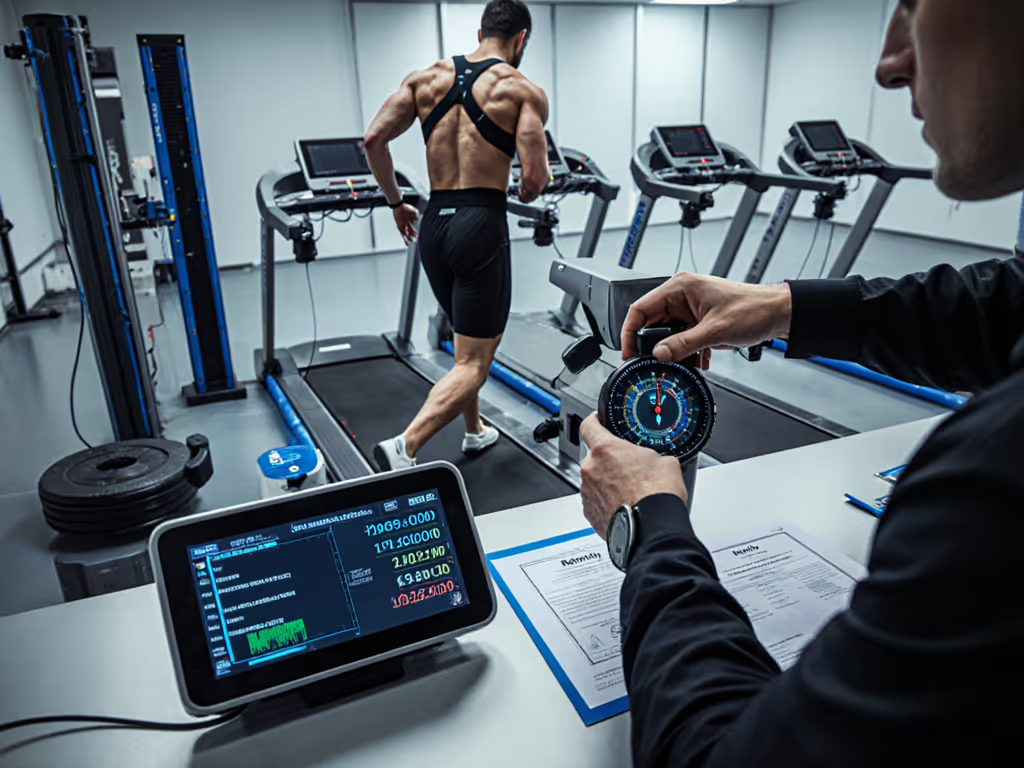
Introduction: When Precision Matters in Every Stride
Sports science metrology and athletic performance measurement have become foundational to elite athletic achievement, yet their principles share surprising parallels with industrial measurement practices I've honed in calibration labs. Just as manufacturing professionals require traceable measurements to satisfy ISO 9001 audits, elite sports organizations now treat every data point with the same rigor, building uncertainty budgets, documenting environmental conditions, and establishing clear traceability chains. When reviewing sports biomechanics data, I immediately assess whether they've accounted for measurement uncertainty as thoroughly as they would for a critical aerospace component. After all, a millimeter or millisecond difference can determine Olympic victory, or scrap a precision part on your shop floor.
FAQ: Sports Science Metrology from an Industrial Metrologist's Perspective
How does sports science metrology differ from industrial metrology, and what principles remain universal?
While the contexts differ dramatically (measuring a sprinter's velocity versus a turbine blade's dimensions), the metrological fundamentals remain identical. Both fields require establishing traceability to SI units, quantifying measurement uncertainty, and controlling environmental factors that influence readings. In sports, as in manufacturing, a measurement without documented uncertainty is merely an observation. The Olympic motto "Citius, Altius, Fortius" (faster, higher, stronger) now demands measurement systems capable of precision down to the thousandth of a second, mirroring the sub-micron requirements in precision manufacturing. What separates adequate from exceptional measurement systems in both fields is the transparency of the uncertainty budget and the documented chain of traceability.
Why must athletic performance measurement systems undergo rigorous calibration like industrial instruments?
Every sports measurement device requires calibration to ensure its readings reflect reality within defined uncertainty limits. Consider timing systems in track events: electronic timing must be traceable to International System of Units (SI) standards, with documented uncertainty values that account for sensor response time, environmental factors, and synchronization errors. Just as I've seen manufacturing teams struggle with inconsistent coordinate measuring machine (CMM) results due to neglected temperature compensation, sports labs face similar challenges when environmental factors like humidity and temperature aren't properly documented in biomechanics measurement protocols. Remember the auditor who once asked for the thermometer calibration behind our CMM room logs? The same scrutiny now applies to Olympic venues where temperature affects track surface resilience and athletic performance.
What are the critical measurement systems in sports that parallel industrial metrology challenges?
Let's examine three measurement domains where sports science faces metrological challenges familiar to manufacturing professionals:
- Timing Systems: Like high-precision stopwatches in calibration labs, Olympic timing systems require documented traceability to atomic clocks with uncertainty budgets accounting for electronic latency, sensor response time, and synchronization errors
- Biomechanics Measurement: Force plates and motion capture systems must be calibrated against known masses and movements, similar to how we verify coordinate measuring machines against gauge blocks
- Environmental Monitoring: Temperature, humidity, and air pressure sensors in competition venues require the same disciplined calibration intervals as environmental sensors in manufacturing cleanrooms
Contextual tools like motion capture systems demonstrate this principle well, whether you're using Sony's mocopi Mobile Motion Capture for training analytics or industrial photogrammetry systems for part inspection, the underlying requirement remains identical: documented calibration against traceable standards with clear uncertainty statements. For a broader look at optical, laser, and ultrasonic options, read our non-contact metrology comparison.
How should organizations approach measurement uncertainty in athletic performance measurement?
An effective uncertainty budget for sports science follows the same structure as one I'd develop for an aerospace component:
- Identify uncertainty sources: Equipment calibration uncertainty, environmental factors, operator technique variability
- Quantify contribution: For example, a force plate's specified uncertainty plus additional uncertainty from floor vibration
- Combine appropriately: Using root sum square methods for independent variables
- Document transparently: Creating an audit trail that shows how each uncertainty component was determined
I've taught manufacturing teams that "measurement without documented uncertainty is merely opinion", and this principle holds equally true when measuring an athlete's vertical jump. When reviewing sports training analytics, I immediately look for documentation of capture volume, sensor calibration intervals, and environmental conditions, just as I would examine a calibration certificate for a coordinate measuring machine.
What environmental factors most significantly impact sports metrology, and how should they be controlled?
Just as manufacturing professionals control temperature in metrology labs to 20°C ±0.5°C, elite sports facilities now maintain strict environmental controls because measurement validity depends on it:
- Temperature directly affects track surface resilience and ball pressure (requiring regular sports equipment calibration)
- Humidity influences air resistance in sprinting and jumping events
- Air pressure impacts projectile motion in throwing events
The key isn't just measurement (it is measurement with documented environmental conditions). When you're evaluating a new athletic training analytics system, ask whether it records and compensates for environmental variables with the same diligence you'd expect from a CMM. In Olympic swimming, for instance, water temperature must be maintained within 0.5°C of the standard, measured with traceable thermometers calibrated against national standards.
Why can't sports organizations skip calibration intervals for measurement equipment, despite tight competition schedules?
This question hits at my core principle as a metrologist: skipping calibration intervals is never acceptable, whether measuring aircraft turbine blades or Olympic sprint times. I've seen too many manufacturing teams rationalize extended calibration cycles only to discover measurement drift that invalidated months of production data. The same risk exists in sports science (imagine certifying a world record based on timing equipment that drifted out of calibration). Documented calibration intervals with clear justification based on historical stability data protect both the integrity of competition and the athletes' careers. As I tell manufacturing teams, and now sports measurement professionals: trace it, budget it, then trust it under audit. If you're formalizing a lab-quality process for sports measurement, see our ISO/IEC 17025 accreditation guide for audit-ready documentation practices.
Building Confidence in Measurement
show your chain of traceability
Whether you're measuring a piston ring's roundness or an athlete's sprint velocity, measurement integrity follows the same fundamental principles. To ground your testing plans, review the difference between accuracy vs precision with practical examples. Elite sports organizations now recognize what precision manufacturers have known for decades: winning isn't just about performance, it is about proving that performance through trustworthy, documented measurements.
For quality professionals looking to deepen their metrology expertise beyond manufacturing applications, I recommend studying the International Organization of Legal Metrology (OIML) guidelines and NIST Handbook 143 on sports measurement standards. These resources demonstrate how metrological principles transcend industry boundaries while maintaining the rigorous documentation that stands up to scrutiny.
Further exploration of these concepts will reveal that whether you're in the calibration lab or Olympic stadium, disciplined measurement practices create trust where it matters most.
Related Articles