
CMM Selection: Bridge vs Gantry for Large Parts
By Priya Deshmukh • 3rd Mar
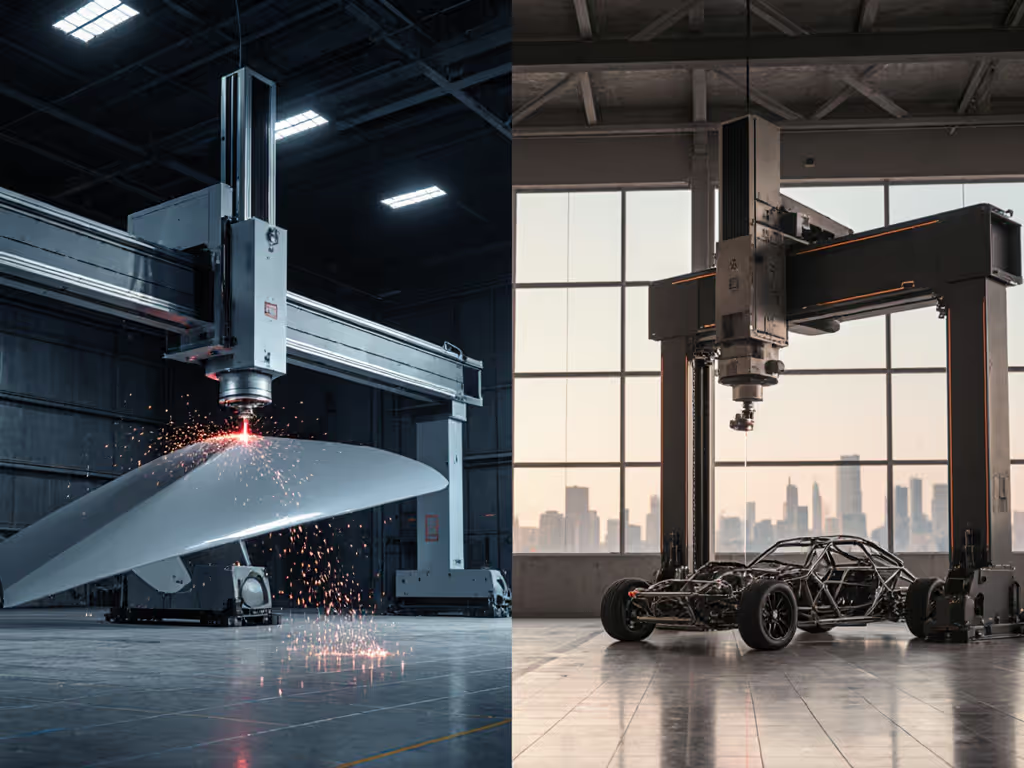
When you're inspecting large, heavy components (aircraft frames, engine blocks, transmission housings), choosing between a bridge CMM and a gantry CMM hinges on part size, measurement volume, floor space, and your team's capacity to manage environmental and workflow variables. Both deliver precision, but repeatability depends as much on how operators handle fixturing and probe technique as it does on machine calibration. If you're sorting out terminology, our guide to accuracy vs precision clarifies why repeatability often dominates real-world results.
Understanding the Core Difference: Scale and Logistics
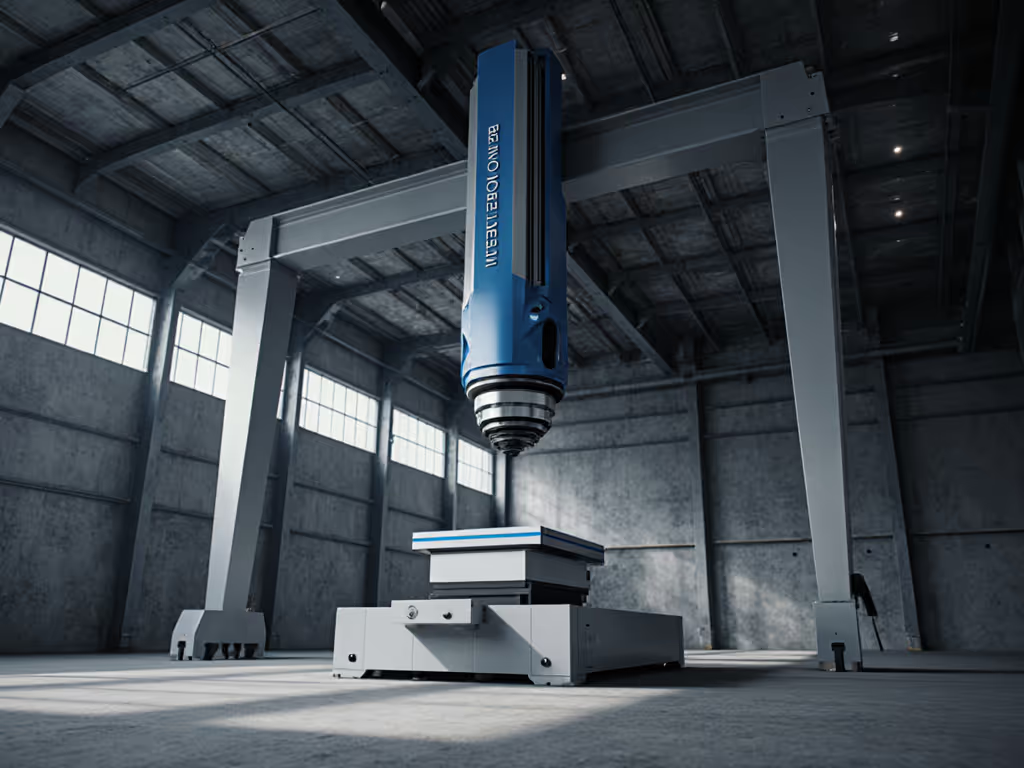
Bridge CMMs are the workhorses of metrology labs. They feature a probe-carrying bridge that travels over a granite table where parts are positioned. For parts that fit on a table (typically up to a few thousand pounds), bridge systems offer high accuracy in a compact footprint. You bring the component to the machine.
Gantry CMMs are scaled-up versions of bridge systems, designed to eliminate the need to lift large or heavy assemblies onto a table. The bridge moves along fixed rails; the part stays on the floor. Gantry machines are commonly used in aerospace, automotive, railway, and defense sectors where assemblies exceed traditional bridge limitations.
The guiding principle: if operators can't repeat it, it doesn't measure. Part logistics (how you load, position, and secure a component) is half the battle.
Bridge CMM: Accuracy When Geometry Fits the Table
Measurement Accuracy and Repeatability
Bridge CMMs are generally considered the most accurate CMM type. This stems from their rigid granite base, which provides thermal stability and vibration damping, and their fixed geometry, which minimizes mechanical deflection. A fact confirmed by industry reports: bridge systems achieve repeatability tighter than gantry equivalents when measuring smaller components. To translate spec sheets into audit-ready numbers, build a simple measurement uncertainty budget for your CMM programs.
Key advantages:
- Highest accuracy among common CMM types
- Excellent thermal and vibration rejection in controlled labs
- Multi-sensor capability (probing and scanning)
- Flexible probe paths for complex geometries
Operational reality check: Bridge CMMs require precision fixturing on a reference surface. If your operator misseats a part, over-torques a clamp, or applies uneven probe pressure, that precision advantage evaporates. I once worked with a team that swapped a beloved digital caliper after discovering operators were unconsciously "thumbing" different pressure on the contact button. A simple force-limiting device and a two-minute teach-back cut their GR&R from 38% to 12%. The machine didn't change; the handling did. The same principle applies to CMM probe-force tuning and part nesting.
Constraints and Trade-Offs
Bridge systems have a fixed measurement volume and lack portability. You cannot easily move a bridge CMM; it must live in a temperature-controlled metrology room. Parts exceeding the table dimensions or weighing more than the safe lifting limit are simply out of bounds. This forces you into custom fixturing, special carts, or breaking assemblies into sub-assemblies (each a potential source of datum shift and assembly error).
Common operational headaches:
- Cannot accommodate parts beyond table size
- Requires lifting, positioning, and securing large components safely
- Needs skilled programming for complex part paths
- Sensitive to lab temperature drift; requires air-conditioning stability
- Downtime during thermal stabilization (typically 2-4 hours after temperature swings)
Gantry CMM: Precision at Scale
Measurement Capability for Large Assemblies
Gantry CMMs accommodate parts ranging from 1 × 2 × 1 m (XYZ) to 4 × 10 × 3 m or larger. They are built directly on the floor on a substantial concrete foundation, specified by the manufacturer and critical to performance. Because parts don't require lifting, gantry systems excel in high-volume environments where cycle time matters and manual part handling is a bottleneck.
Gantry accuracy is strong, second only to bridge systems, and gantry machines are commonly used in aerospace and automotive manufacturing where large parts demand traceable measurements. For very large parts or field validation, compare laser trackers vs portable CMMs to understand setup time and accuracy tradeoffs.
Advantages:
- Large measurement volume eliminates sub-assembly complexity
- Easy loading and unloading of heavy components
- Floor-mounted design avoids lift-related damage or operator strain
- Multi-sensor capability (probes, laser scanners)
- Suitable for in-production area measurement (some models are "shopfloor" rated) For the tradeoffs between in-line vs off-line inspection, see our practical comparison.
Structural and Environmental Realities
Gantry machines are less forgiving of environmental variation than bridge systems because their large structure (typically 1.5 to 2 meters in height for smaller units, up to 4 meters for Z-axis on larger machines) creates more thermal mass and longer stabilization times. They also require a stable foundation; floor vibration, settling, or nearby heavy machinery operation can drift datum references.
Operational constraints:
- Substantial capital investment; typically higher than bridge systems
- Needs dedicated floor space and reinforced foundation
- Large footprint prevents frequent relocation
- Sensitive to vibration; unsuitable for shop floors with presses, shears, or vibration-heavy equipment nearby
- Requires skilled programmers; complex to set up for new part geometries
- Thermal stabilization may take 4-8 hours; longer than bridge in some cases
Repeatability: Where Workflow Meets Hardware
Chasing measurement repeatability over theatrics means hardening three critical areas: fixturing repeatability, probe technique standardization, and environmental management.
Fixturing and Datum Control
Bridge systems: You must design a fixture that repeats part position on the granite table to within microns. Magnetic clamps, V-blocks, and precision parallels are standard. If the fixture itself drifts (worn clamping surfaces, magnetic decay, or parallel distortion), you inject uncontrolled variation. A teach-back routine is non-negotiable: have a second operator repeat the fixture setup blindly and compare probe hits.
Gantry systems: Floor-mounted fixtures or carts must be repeatable and stable. Parts larger than the gantry's Z-range often sit directly on the floor, making datum repeatability harder. Surface flatness, coolant residue, and debris become sources of datum shift. A visual anchor (a paint mark or witness line) showing proper part orientation saves costly re-runs.
Probe Force and Technique
Probe stylus force affects measurement repeatability far more than people realize. Soft materials (aluminum, composites) can yield under probe pressure, introducing 5-10 microns of false contact. Standardize probe force across your team:
- Teach-back checklist for CMM operators:
- Confirm probe stylus is clean and dry before each setup
- Record stylus force setting in the job traveler (e.g., "0.5 N for aluminum, 1.0 N for steel")
- Perform a three-point probe qualification on a reference standard before running parts
- Log probe wear (spherical deflection) monthly and retire styluses at manufacturer limits
- Have a second operator verify qualification results
Environmental Factors: Temperature, Vibration, Coolant
Bridge labs are typically climate-controlled to ±1 °C. Gantry systems in production areas may experience 3-5 °C swings, which translates to 0.3-0.5 mm of thermal growth on large parts (steel coefficient ≈ 12 µm/m/°C). If your tolerance stack is already tight, thermal drift eats margin.
Practical guidance:
- For gantry systems in production, allow 4-8 hours post-measurement before reporting final results; temperature creep continues
- Coolant vapor and mist accelerate probe wear and degrade optical scanning; protective covers and air curtains are cost-effective
- Isolate gantry systems from presses, stamping lines, and forging hammers; foundation-level vibration is invisible but real
- Use thermal barriers and draft screens if moving parts between cool storage and warm production areas
Comparing Accuracy Tiers
Measurement accuracy depends on calibration, maintenance, and operator skill. A rule of thumb in regulated industries (aerospace, medical devices): apply a 4:1 test accuracy ratio (TAR) or 10:1 tolerance-to-uncertainty ratio.
| CMM Type | Typical Accuracy (µm) | Best Use Case | Repeatability Sensitivity |
|---|---|---|---|
| Bridge | ±2-5 | Machined parts, optical components, < 2 m parts | High - fixture and probe force critical |
| Gantry | ±3-8 | Large/heavy assemblies, aerospace frames, in-production checks | High - environment and foundation impact significant |
| Portable/Arm | ±5-15 | Field verification, large structures, rough inspection | Moderate - operator technique is dominant |
Accuracy varies by machine age, calibration interval, and environmental control. Always verify with your equipment manual and recent calibration certificates.
Workflow Integration: Shop Floor vs. Lab
Bridge CMM Workflow
Bridge systems thrive in dedicated metrology labs where environmental control, dedicated operators, and batch-mode measurement are feasible. A typical workflow:
- Part arrival → quarantine until lab space available
- Thermal soak (1-2 hours)
- Fixture design and setup (if custom)
- Probe qualification → measurement → data analysis
- Result reporting and part release
Cycle time is measured in hours; gating is lead time, not measurement speed. Ideal for final assembly inspection, certification holds, and design verification.
Gantry CMM Workflow
Gantry systems integrate into production. Parts are staged directly for measurement with minimal handling. A typical workflow:
- Part arrives at gantry staging area
- Visual checklist: orientation verified via witness mark, cleanliness check
- Load onto gantry pallet or floor fixture (typically < 10 min)
- Automated probe path or manual jogging
- Real-time SPC feedback to production scheduler
- Part released to next station or hold per quality gate
Gantry allows in-process capability studies and first-article runoff verification without shop-floor bottlenecks. However, operator discipline is essential; a rushed setup or missed datum reference becomes scrap downstream.
Environmental Impact on CMM Performance
Temperature, humidity, and vibration are often the invisible culprits in measurement disputes.
Temperature sensitivity:
- Granite thermal mass smooths short-term swings but doesn't eliminate long-term drift
- A 5 °C rise over 4 hours can shift a 2-meter part by 0.12 mm on a steel component
- Bridge labs target ±1 °C stability; gantry areas may achieve ±2 °C with effort
Vibration isolation:
- Isolate gantry CMMs from floor-mounted vibration sources; use elastomeric pads if needed
- Keep distance from press lines and heavy machinery (recommend > 10 meters, line-of-sight)
- Monitor foundation settling annually; differential subsidence causes datum shift
Cleanliness and coolant:
- Optical probe paths degrade rapidly if mist-laden; maintain air filtration
- Probe styluses wear faster in coolant-heavy environments; schedule stylus replacement every 500-1000 measurement cycles (varies by part material and probe force)
Selection Criteria: Ask These Questions
-
What is the largest part you'll measure in the next 3 years, by weight and dimension? If it exceeds your bridge table, gantry is mandatory. If your largest part is < 1 m and < 500 kg, a bridge system is more cost-effective.
-
What is your measurement cycle time requirement? In-process checks demand gantry speed and floor positioning. Design verification and final audit can tolerate lab queuing; bridge is viable.
-
Can you maintain a climate-controlled metrology room? If your facility averages ±1 °C and has UPS-backed cooling, bridge achieves higher accuracy. If you're in a production area with ±5 °C swings, gantry in a protected alcove is pragmatic, but accept ±2-3 µm additional uncertainty.
-
Do you have a stable floor and foundation budget? Gantry systems demand reinforced concrete and geological survey; bridge systems can sit on a raised platform. Budget accordingly.
-
What is your operator skill baseline and training capacity? Both require trained programmers, but bridge programming is more standardized. Gantry setup is more art; invest in senior technician mentoring.
Practical Next Steps for Your Facility
If you're evaluating a CMM purchase:
1. Conduct a 12-month measurement log. Capture part sizes, weights, tolerance stacks, and current inspection throughput. Identify the 80th percentile part (the real workload, not the exceptions). This data drives CMM sizing.
2. Develop a fixturing and technique standard. Write a one-page "CMM operator card" for your top 5-10 recurring parts. Include probe force settings, thermal soak time, fixture orientation cues, and a teach-back verification step. Repeatability over theatrics.
3. Request a trial measurement. Ask vendors to bring a demo unit or loan a portable arm. Measure a real part from your queue and verify GR&R against your current process (calipers, bore gages, etc.). GR&R targets: < 10% for final inspection, < 15% for in-process.
4. Assess your environment. If bridge, audit lab HVAC and request ±1 °C capability. If gantry, survey floor flatness (< 5 mm over 10 m) and check for vibration sources within 50 meters.
5. Build a 3-year total cost of ownership (TCO) model. Include purchase price, installation/foundation, annual calibration (typically $2-5 K for bridge, $5-10 K for gantry), stylus and probe replacement, and training labor. For budgeting beyond sticker price, this fixed vs portable metrology TCO guide breaks down calibration, maintenance, and productivity impacts. Gantry TCO often justifies itself within 2 years if measuring > 50 large parts annually.
6. Plan operator onboarding. Schedule 40 hours of hands-on training for your primary operator before deployment. Certification (via ASME Y14.5 or ISO GPS) is optional but builds confidence and audit-readiness.
The right CMM is the one your team can use consistently, under real shop conditions, and defend in an audit. Repeatability lives in the details: the datum nest, the probe force, the thermal soak, the second-operator check. Choose the machine that fits your workflow, then invest in the habits that make it repeatable.
Related Articles