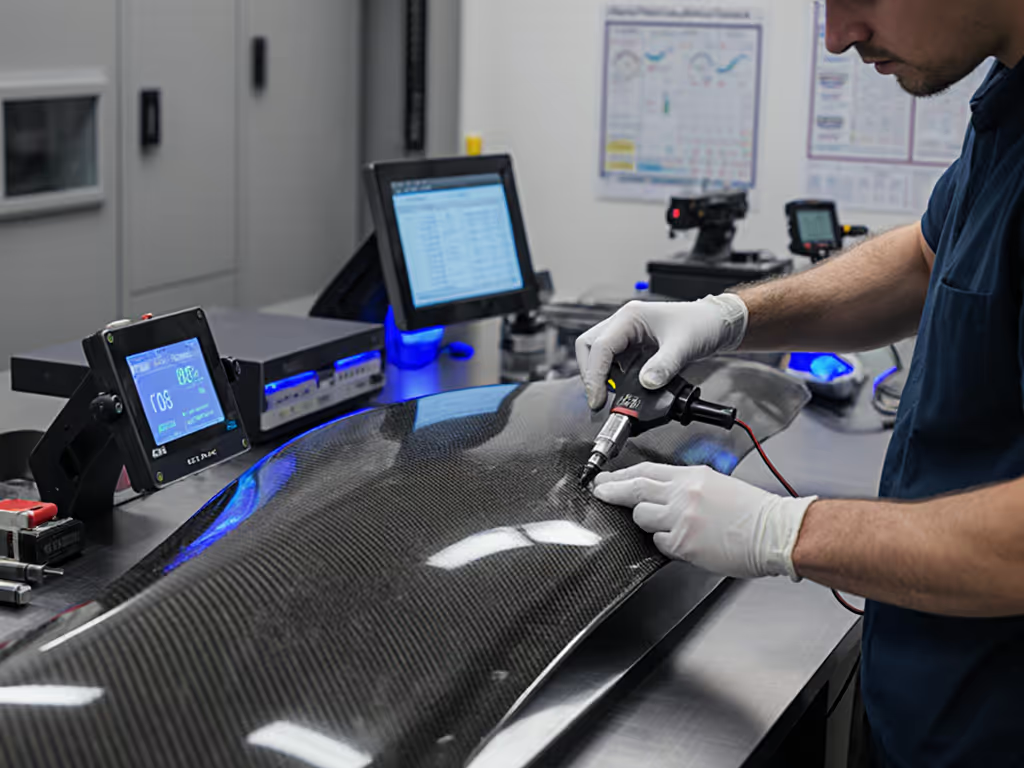
Offshore Wind Turbine Metrology Tools That Resist Corrosion
By Greta Lund • 17th May
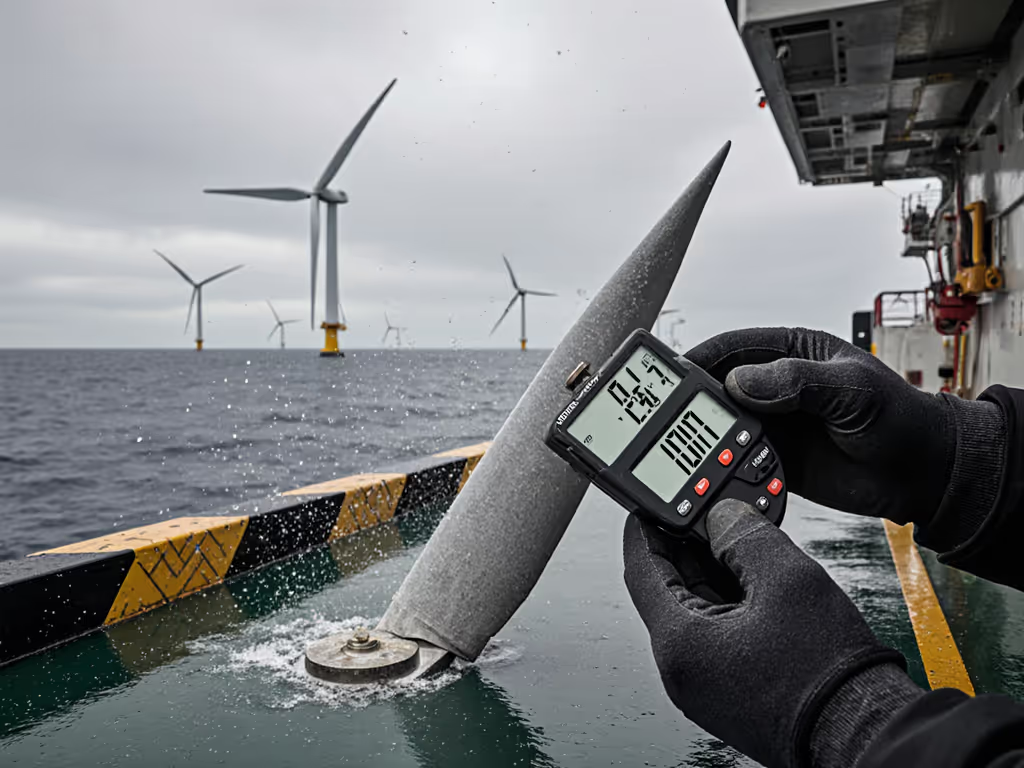
Offshore wind turbine metrology is unforgiving: your marine environment measurement tools must stay accurate while surrounded by salt spray, vibration, and constant weather cycles. If your instruments corrode, drift, or lose sealing, your Cp/Cpk numbers, GR&R studies, and inspection records stop being evidence and turn into exposure.
This guide translates offshore conditions into concrete tool and documentation requirements, then walks through a detailed, spec-driven review of a sealed optical assembly as a reference point for durability and enclosure design in harsh marine environments. The focus is practical: tying tolerance, environment, and lifecycle documentation together so you can defend your measurements under audit and under storm.
If it isn't documented, it's hope, not evidence under pressure.
1. How Corrosion Undermines Metrology at Sea
Saltwater does not just rust metal; it quietly distorts measurements. In offshore wind farm inspection, you may be checking tower flange flatness, bolt elongation, blade root dimensions, or performing corrosion measurement at sea on welds and splash-zone structures. For large curved components in particular, see our blade measurement comparison to select the right inspection approach offshore. Each of these tasks assumes the tool you hold is dimensionally stable and traceable.
1.1 Mechanisms that Matter for Measurement
Relevant corrosion and degradation mechanisms include:
- Uniform corrosion - gradual loss of material on exposed steel surfaces, altering reference faces or contact points.
- Pitting and crevice corrosion - localized attack, especially on stainless near chloride deposits; can change the geometry of anvils, jaws, and reference pads.
- Galvanic corrosion - dissimilar metals (e.g., stainless body with carbon-steel fasteners) in conductive seawater; fastening points and interfaces loosen, impacting repeatability.
- Stress corrosion cracking - under tensile stress (springs, flexures, thin structural members), can cause sudden failure or loss of stiffness.
- UV and environmental aging - plastics, seals, and cables embrittle or crack, compromising IP sealing.
Metrological impact:
- Jaw faces on calipers and micrometers lose flatness and parallelism.
- Reference surfaces on fixtures warp or pit, increasing uncertainty.
- Spring constants in indicators and probes change, altering probe force and hysteresis.
- Loss of sealing lets in condensation, affecting electronics and scale readings.
A nominal 0.01 mm resolution device with corroded contact faces may carry an unquantified +/-0.05 mm error. Without an explicit uncertainty budget and environmental controls, saltwater-resistant metrology remains marketing language, not a controlled capability. If you need a starting point, use our measurement uncertainty budget guide to formalize contributors and evidence.
1.2 Risk Note
Risk note: Any instrument stored or used in the splash zone, transition piece, or exposed deck should be treated as operating in an accelerated corrosion test. If your calibration strategy assumes benign laboratory conditions, it is misaligned with reality offshore.
2. Requirements for Marine Environment Measurement Tools
To select marine environment measurement tools that genuinely hold up offshore, define requirements across three domains: environment, metrology performance, and documentation.
2.1 Environmental Requirements
Key parameters for offshore wind turbine metrology tools:
- Ingress Protection (IP) rating
- For deck-level handheld electronics: typically IP65 to IP67 minimum. Not sure what those codes mean? Start with our IP rating guide for waterproof measuring tools for harsh environments.
- For permanently mounted sensors or loggers in exposed locations: often IP67 to IP68 or higher, sometimes with additional enclosure ratings.
- Materials and coatings
- Structural and fastener materials: 316/316L stainless, duplex stainless, or well-specified aluminum with marine-grade anodizing.
- Surface treatments: passivation per standards (e.g., ASTM A967), or coatings compliant with offshore paint systems (e.g., ISO 12944 categories C5-M / CX).
- Temperature and humidity
- Operating range at least -10 °C to +50 °C with specified humidity limits.
- Condensation management: breather vents or desiccant packs in enclosures.
- Vibration and shock
- For nacelle-mounted systems, documented testing to relevant vibration profiles (e.g., IEC 61400 related profiles for wind turbines, or equivalent).
Acceptance criteria (environment): The tool's datasheet must state IP rating, material family, and environmental test conditions, not just generic phrases like "rugged" or "weatherproof."
2.2 Metrological Requirements
Resolution tells you how many digits; accuracy and repeatability determine how much risk you carry.
For typical offshore dimensional checks:
- Choose tools to meet at least a 4:1 test accuracy ratio (TAR) between tool uncertainty and feature tolerance; 10:1 where feasible for critical safety-related dimensions.
- Require:
- Accuracy specified over a defined temperature range.
- Repeatability and hysteresis data for indicators and probes.
- Clear calibration intervals, ideally tied to ISO/IEC 17025 accredited labs.
Acceptance criteria (metrology): Each instrument should have a recent calibration certificate with uncertainties stated and traceable to national standards.
2.3 Documentation & Control
The most robust stainless tool still fails you if the paperwork doesn't survive an audit.
Minimum documentation set for offshore wind farm inspection tools:
- Unique asset ID linked to:
- Model, serial number
- IP rating and material notes
- Location (onshore lab, offshore site, specific vessel)
- Calibration record including:
- Standard used, environmental conditions, uncertainty
- As-found and as-left data
- Use and care work instructions
- Cleaning after salt exposure
- Storage conditions
- Maximum exposure duration before inspection
Add explicit revision callouts on every SOP that touches measurement or corrosion control. When you update a cleaning procedure or inspection frequency, control the revision; unlabelled PDFs circulating on a vessel are an invitation to nonconformities.
If it isn't documented, it's hope, not evidence under pressure.
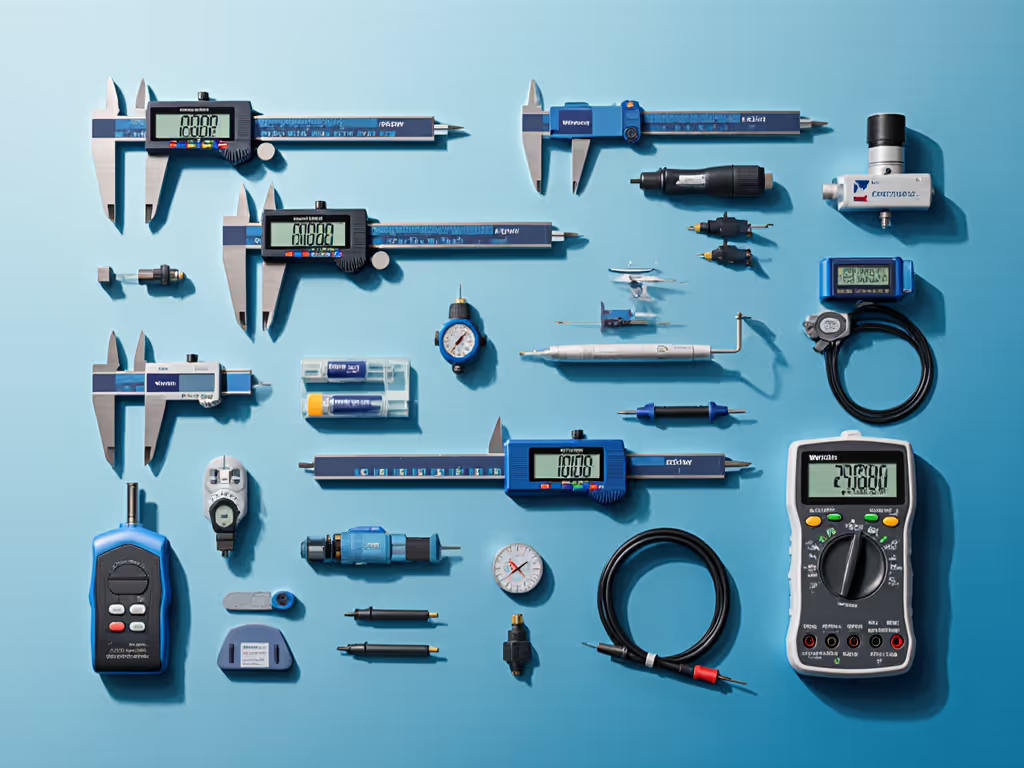
3. Tool Classes in Offshore Wind Turbine Metrology
Before we look at a specific sealed assembly as a case reference, it helps to map the landscape of offshore wind turbine metrology tools and their corrosion-related needs.
3.1 Handheld Dimensional Tools
Examples: calipers, micrometers, dial/digital indicators, bore gages.
- Risks: Pitting of contact faces, contamination of sliding ways, ingress into electronic scales.
- Controls:
- Prefer stainless frames with chrome-plated or ceramic faces where feasible.
- Gaskets and seals compatible with oils and salt.
- Routine flushing and drying with controlled cleaning agents.
3.2 Surface and Corrosion Measurement Tools
Examples: ultrasonic thickness gages, pit depth gages, coating thickness meters.
- Risks: Corrosive attack on transducer housings, connectors, and cables; loss of coupling efficiency.
- Controls:
- IP67 or better enclosures for portable units.
- Replaceable, sealed transducers.
- Documented compatibility of couplants and cleaning procedures.
This is where corrosion measurement at sea is most direct: you are quantifying wall loss and pitting while the structure is exposed to salt, spray, and fluctuating temperature.
3.3 Alignment and Positioning Systems
Examples: inclinometers, total stations, laser trackers, GNSS-based systems. For large structures, compare laser trackers vs portable CMMs to choose a system that holds accuracy in wind farm conditions.
- Risks: Optical windows fogging or scratching, internal condensation, alignment drift from thermal gradients.
- Controls:
- Protective windows with hydrophobic/oleophobic coatings.
- Enclosures with pressure equalization and desiccant.
- Defined warm-up and stabilization times for measurements.
3.4 Environmental Sensors
Examples: temperature, humidity, salinity, vibration sensors.
These form the evidence links between your uncertainty budget and the actual environment. Without them, your MSA assumptions are guesses.
4. A Sealed Optical Assembly as a Durability Reference
The affiliate product associated with this article is not a metrology instrument; it is an automotive headlight assembly: the labwork Headlights Assembly Replacement for Fusion 2013-2016 4-Door Sedan Halogen Models, a direct-fit driver/passenger set made from ABS plastic with a clear polycarbonate lens and sealed housing.

labwork Headlights Assembly for Fusion 2013-2016
Restore clear, safe nighttime driving visibility with direct-fit halogen headlight replacement.
$139.9
Vehicle CompatibilityFusion 2013-2016 (Halogen Models)
Vehicle CompatibilityFusion 2013-2016 (Halogen Models)
Pros
Ensures strong light penetration for all weather conditions.
Easy, direct-fit installation without vehicle modifications.
Cons
Bulbs are not included in the assembly.
Adjustment difficulties reported, especially driver's side.
Customers report that the headlights generally fit well and are of good quality, with some noting they came with bulbs despite product images. However, a recurring complaint is difficulty with adjustment, particularly for the driver's side, leading to poor light direction.
Customers report that the headlights generally fit well and are of good quality, with some noting they came with bulbs despite product images. However, a recurring complaint is difficulty with adjustment, particularly for the driver's side, leading to poor light direction.
Why does an automotive headlight matter in a discussion of offshore wind turbine metrology?
Because many of the same engineering controls that keep headlights performing under road spray, temperature swings, and vibration also apply to enclosures, windows, and illumination used alongside marine environment measurement tools. When you specify protective housings for cameras, laser optics, or inspection lighting on turbines and vessels, you are effectively buying a "headlight-class" component.
We will therefore treat this assembly as a case reference for:
- Environmental sealing and materials
- Optical clarity and beam control
- Shock and vibration tolerance
- Serviceability and lifecycle behavior
All parallels drawn are about enclosures and inspection lighting, not about using this component as a measuring device.
5. Detailed Evaluation of the labwork Headlight Assembly as an Offshore Reference Design
5.1 Environmental Sealing & Materials
Specification overview (controlled language):
- Housing material: ABS plastic
- Lens material: clear polycarbonate
- Application: front headlight assembly, halogen light source
- Structure: driver and passenger set, plug-and-play replacement, internal support structure for vibration performance
ABS housings and polycarbonate lenses are standard in automotive lighting because they offer:
- Impact resistance - surviving gravel, minor impacts, and handling.
- Dimensional stability - holding shape under moderate temperature cycles.
- Formability - enabling complex sealing geometries.
From a saltwater-resistant metrology viewpoint, these same attributes matter when you design or select:
- Protective covers for laser tracker optics
- Housings for machine vision cameras on nacelles
- Enclosures for on-tower LED inspection lighting
Strengths as a reference design:
- The assembly demonstrates good sealing: users note that the unit keeps contaminants out, and the manufacturer highlights the housing's ability to prevent impurities entering the optical cavity.
- The simple internal support structure and focus on vibration performance are analogous to how you should evaluate instrument mounts and fixtures for offshore environments.
Risk note (environmental gap to offshore):
- Automotive duty cycles and salt exposure (road salt, spray) are significant but not equivalent to full marine exposure (continuous chloride atmosphere, potential immersion, offshore UV and wind). For direct offshore deployment, you would demand:
- Explicit IP rating (e.g., IP67) confirmed by test.
- Documentation on UV stabilization and salt-fog testing (e.g., per ISO 9227 or equivalent).
When you assess housings for offshore measurement tools, require these data. Use automotive-grade assemblies like this as a minimum bar, not the final specification.
5.2 Optical Performance & Ergonomics
While this product's primary role is vehicle lighting, the same factors drive inspection lighting in offshore wind farm inspection:
- Clear, undistorted illumination of surfaces
- Controlled beam patterns to avoid glare and dark spots
- Stable performance in rain and fog
Customer feedback on this assembly indicates:
- Generally good optical quality and brightness, providing adequate vision even in adverse weather.
- However, some users report difficulty with adjustment, particularly on the driver's side, leading to suboptimal beam direction.
Relevance to metrology and inspection:
- For close-range measurement tasks (e.g., checking bolt stretch indicators, surface defects, or gauge readings under low light), mis-aimed lighting creates shadows, glare, and eye strain. That can lead to mis-reads, especially when technicians wear PPE and work quickly.
- A sealed optical assembly intended to support marine environment measurement should therefore include:
- Repeatable mechanical aiming with clear detents or scales.
- A documented adjustment procedure with revision control.
Acceptance criteria (inspection lighting):
- Beam pattern documented (e.g., lux vs distance diagrams).
- Adjustment method, torques, and alignment references clearly stated.
- Compatibility with gloves and PPE considered in the design.
5.3 Installation, Maintainability, and Lifecycle
The labwork headlight assembly is marketed as a plug-and-play, vehicle-specific fit with no modification of wiring required. It uses existing mounting points and reuses stock bulbs.
Positive aspects (lessons for offshore equipment):
- Standard interfaces: Similar to using standardized mounting plates and connectors for metrology tools and enclosures on turbines. Reduces downtime and configuration errors.
- Modular replacement: Entire assembly can be swapped instead of field-repairing a cracked housing; this is analogous to replacing sealed sensor or camera pods rather than attempting ad-hoc repairs offshore (which I won't condone if undocumented and unqualified).
- Material simplicity: Fewer material types in contact reduce galvanic corrosion drivers.
Lifecycle considerations:
The headlight's simple internal structure and focus on vibration resistance imply a conservative, robust design. For offshore measurement systems, prioritize similarly proven architectures over novel, untested mechanisms.
However, you must extend the lifecycle view beyond the unit itself:
- Cleaning protocol - how often can you expose the lens to salt spray before cleaning is mandatory?
- Inspection interval - when do you inspect seals and mounting hardware for degradation?
- Replacement triggers - defined thresholds for crazing, yellowing, or loss of sealing.
Document these as part of your metrology or inspection asset plan. When management asks why you are replacing enclosures or optical windows on a schedule, you should have evidence links from materials data and environmental exposure, not anecdotes.
5.4 Comparison to Typical Offshore-Grade Lighting & Enclosures
Compared to purpose-built offshore lighting and camera housings, this automotive headlight illustrates both the strengths and limitations of repurposing road-grade designs:
Strengths:
- Competitive cost due to high production volume.
- Proven performance under vibration and moderate salt exposure.
- Clear polycarbonate optics with engineered beam pattern.
Limitations for offshore deployment:
- No declared IP rating or marine corrosion classification.
- Unknown gasket materials vs long-term oil, UV, and salt exposure.
- No explicit documentation of salt-fog, UV, or marine immersion testing.
For your offshore wind turbine metrology infrastructure, treat this kind of component as a conceptual benchmark: the minimum level of sealing, optical clarity, and modularity you should expect. Then, specify additional requirements needed for a true marine environment measurement context.
6. Checklist: Selecting Saltwater-Resistant Metrology Systems
To move from concepts to purchasing decisions, use this spec-driven checklist. It ties together environmental, metrological, and documentation controls.
6.1 Define the Measurement Use Case
- Feature(s) to measure (dimension, angle, thickness, corrosion depth, alignment).
- Tolerance(s) and required process capability (Cp/Cpk targets).
- Location and exposure:
- Onshore lab
- On-port warehouse or staging yard
- Offshore platform, transition piece, or nacelle
6.2 Map Tolerance to Tool Capability
- Determine needed TAR (4:1 minimum, 10:1 preferred).
- Verify tool accuracy and repeatability over expected temperatures.
- Confirm resolution is adequate but not the sole selector (accuracy dominates).
6.3 Environmental & Corrosion Controls
- IP rating at or above required level (IP65+ for handheld offshore use).
- Materials confirmed as:
- 316/316L stainless, duplex, or coated aluminum
- Corrosion-resistant plastics and seals with UV and chemical data
- Evidence of testing:
- Salt-fog, UV, vibration, shock, condensation.
6.4 Integration and Data Capture
- Interface to SPC/QMS systems (Bluetooth, USB, fieldbus), with documented firmware behavior.
- Compatibility with gloves and PPE (button size, display readability).
- Data logging and timestamping to link measurements with environmental conditions when needed.
6.5 Documentation & Training
- ISO/IEC 17025 traceable calibrations with uncertainty budgets.
- Clear work instructions on:
- Cleaning, storage, and allowed exposure
- Technique (avoiding cosine and Abbe errors, correct probe force)
- Training records and MSA/GR&R studies filed under controlled revision.
Acceptance criteria (procurement gate): Do not approve any tool or enclosure without complete environmental and metrological documentation. Marketing terms such as "marine grade," when not backed by standards and test reports, are insufficient.
7. Documentation and Audit Readiness Offshore
Offshore projects face the same audits as aerospace and automotive plants, often with tighter scrutiny due to safety and environmental stakes.
To be ready:
- Asset register: Map every metrology and inspection asset to:
- Location (turbine, platform, vessel, lab)
- Environment severity rating
- Calibration and maintenance intervals adjusted for that severity.
- Calibration strategy:
- High-value or complex instruments: calibrate onshore in controlled labs. Align your program with our ISO/IEC 17025 accreditation guide to ensure audit-ready calibration documentation.
- Simple gauges: establish verified on-site checks with traceable standards and clear go/no-go criteria.
- Change control:
- When you change a cleaning agent, storage location, or replacement interval, treat it as a formal change.
- Update SOPs and checklists and control the revision; obsolete instructions must be removed from vessels and workstations.
- Evidence package for auditors:
- Recent calibration certificates.
- Environmental specifications and test summaries.
- MSA/GR&R summaries for critical measurements.
A brief, well-organized binder (or digital equivalent) is the difference between a 12-minute review with signatures and an afternoon of questions about unlabelled procedures and unlabeled tools.
8. Implementation Roadmap for Offshore Metrology Robustness
To improve your offshore wind turbine metrology capability without chaos:
-
Survey existing tools and enclosures
- Classify by environment (lab, port, offshore).
- Identify tools exposed to salt that lack IP ratings or material specs.
-
Prioritize by risk
- Focus first on measurements that protect safety, structural integrity, or high-value components.
-
Upgrade enclosures and lighting
- Use lessons from sealed automotive assemblies (like the labwork headlight) to demand at least that level of sealing, modularity, and adjustability.
- Then add marine-specific requirements: salt-fog, UV, IP, and documented materials.
-
Align calibration and maintenance intervals
- Shorten intervals for instruments stored or used offshore.
- Add intermediate on-site verification checks where removal for calibration is difficult.
-
Train and document
- Provide focused micro-training on handling, cleaning, and basic technique.
- Update SOPs and log training completion with asset references.
-
Review and refine via MSA and field feedback
- Perform GR&R on critical measurements under realistic offshore conditions.
- Capture feedback from technicians on usability (readability under rain, handling with gloves, beam placement of inspection lights).
Conclusion: Where to Explore Next
Offshore wind turbine metrology lives at the intersection of precision, corrosion science, and documentation discipline. Marine environment measurement tools must do more than survive salt; they must keep their uncertainties known, controlled, and defensible.
A sealed automotive headlight assembly, such as the labwork replacement for the 2013-2016 Fusion, illustrates how robust housings, clear optics, and modular replacement can inform your expectations for enclosures and inspection lighting. But offshore use demands additional, explicitly documented protections and standards.
For further exploration:
- Deepen your understanding of corrosion categories and protective coatings (e.g., offshore classifications under widely used standards).
- Compare IP and environmental test data across metrology vendors, not just accuracy specs.
- Benchmark your current lighting and enclosure solutions against proven sealed assemblies, then incrementally raise the bar to true marine-grade performance.
The goal is not to chase exotic technology. It is to build a metrology system (tools, enclosures, lighting, and documentation) that quietly resists corrosion, passes audits without drama, and lets your team make reliable decisions in one of the harshest measurement environments on earth.
Related Articles