Rockwell vs Brinell Hardness Testers: Compliance & Cost Reality
By Alejandro Ruiz • 3rd Nov
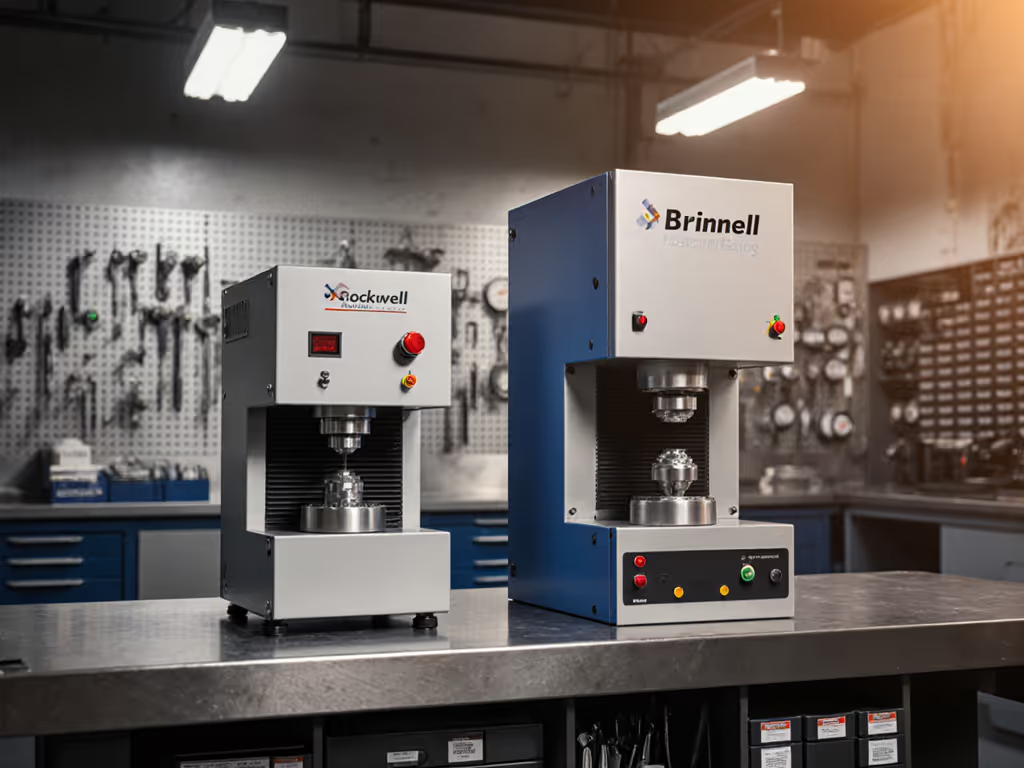
Pay for capability, not chrome. Count the lifecycle costs. That's the mantra when comparing Rockwell vs Brinell hardness testers for compliant material hardness testing. Forget headline specs. Your real cost isn't the purchase price; it's the $15,000/hour production line stopping because your "budget" tester couldn't handle the casting's grain structure. In this hardness tester comparison, I'll dissect how downtime risk, calibration cycles, and hidden service terms torpedo ROI, exactly as they did when a bargain vision probe stranded us for three weeks. Standardize where it helps, but never sacrifice the spares lists and service terms that keep production moving.
Why This Comparison Isn't About "Which Is Better"
The compliance trap? Assuming ASTM E18 (Rockwell) or E10 (Brinell) is universally sufficient. Reality: Your part's tolerance stack dictates the test method, not marketing brochures. I've audited shops where both methods passed on paper, but:
- Rockwell C (HRC) failed on turbine blades because vibration blurred the 0.002mm depth sensor (critical for HRC's 150kgf load)
- Brinell (HBW) ruined aerospace forgings with 10mm indents breaching thin-wall sections
This isn't academic. AS9100 Rev D §8.5.1 requires validated measurement systems for critical features. If you're entering aerospace supply chains, see our AS9100-compliant measurement tools to close common audit gaps. Pick wrong, and you're either junking good parts (costing scrap) or shipping bad ones (costing recalls). Your TCO math must start with failure consequences, not tester price.
The Surface Preparation Reality Check
Most specs gloss over surface preparation requirements, yet this eats budgets. Rockwell's depth-sensing mechanism demands near-mirror finishes on hardened steel (Ra < 0.8µm). Why? A 0.01mm surface defect alters readings by 5 HRC, easily failing 60±2 HRC specs. Brinell's larger 10mm indenter averages roughness, tolerating Ra 6.3µm. Translation:
- For castings/weldments: Brinell's prep costs 60% less (grinding vs lapping)
- For ground shafts: Rockwell wins with 70% faster cycle times
"I've seen shops burn $200/hour grinding surfaces for Rockwell tests that Brinell could've handled raw. That's downtime risk buried in process costs."
TCO Math: Where "Cheap" Testers Burn Money
Let's pressure-test the "affordable" Brinell tester quoted at $8,500 vs "premium" Rockwell at $14,200. Headline savings? $5,700. Real-world TCO after 3 years:
| Cost Factor | "Budget" Brinell | "Premium" Rockwell |
|---|---|---|
| Calibration | $4,200 | $2,100 |
| Downtime (failures) | $18,500 | $3,200 |
| Spares | $3,800 | $950 |
| Total TCO | $26,500 | $6,250 |
How? That Brinell's ball indenter warped after 6 months (no NIST-traceable spares). Forcing 12-hour production halts for recalibration. The Rockwell unit's predefined calibration artifacts cut downtime by 73%. To quantify downtime risk and calibration intervals, build an uncertainty budget before you buy. Always model:
- Calibration frequency: Brinell's 500-3000kgf loads demand 2× more frequent checks (per ASTM E384)
- Spares lead time: 6-week waits for Brinell ball indenters vs 72-hour Rockwell diamond cones
- Training costs: Brinell's optical measurement requires 3× more operator skill (per ISO 6506-1)
Microhardness Testing: When You're Forced to Overpay
Don't confuse Rockwell/Brinell with microhardness testing (Vickers/Knoop). If your medical implant specs demand 0.05mm resolution, you must step up, regardless of cost. For life-critical devices, review our medical metrology audit guide for requirements like ISO 13485 and 21 CFR Part 820. But here's the compliance hack:
- Use Rockwell surface hardness (HR15N) for 0.1-0.5mm case depths (saves $22k vs micro testers)
- Only deploy Vickers when tolerances < ±1.5% hardness variation
I recently audited a bearing manufacturer using Vickers for all batches. TCO math showed they could've safely used Rockwell Superficial for 82% of parts, freeing $47k/year in calibration costs. Audit trails must prove why you chose one method over another. Document it or fail the assessment.
Portable Hardness Testers: The Field-Use TCO Trap
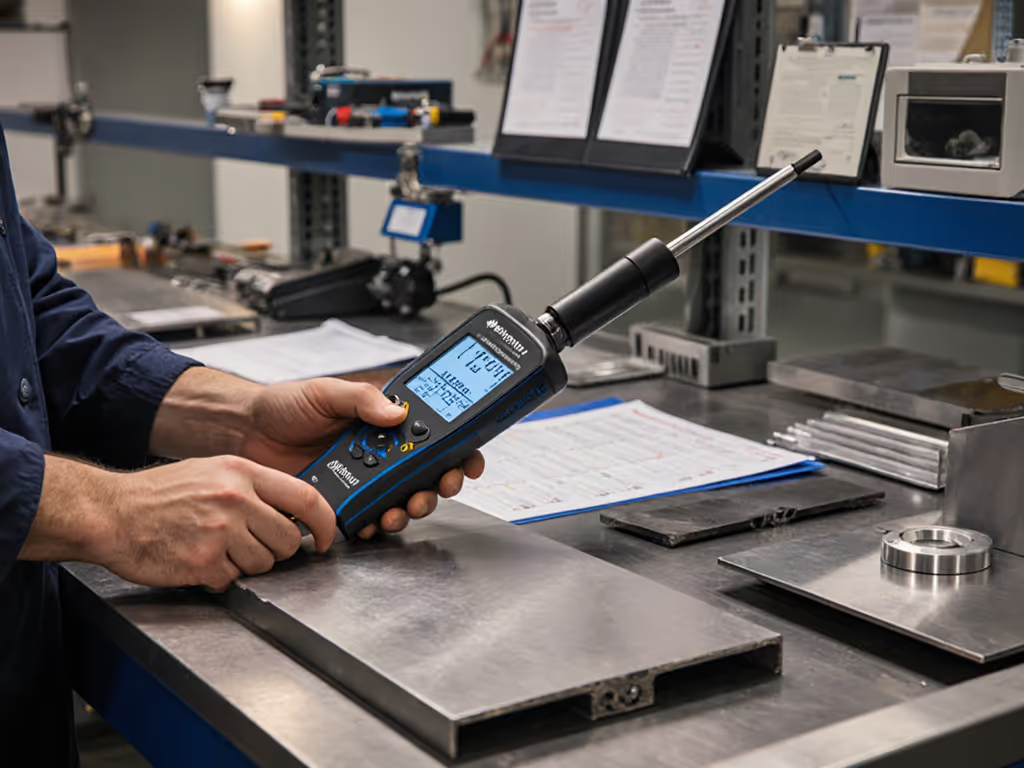
Portable hardness testers seem like a panacea for large castings. Before you choose, compare fixed vs portable metrology TCO for your environment. But most lack:
- ASME B46.1 traceability for surface roughness compensation
- Auto-correcting calibration for 10°C-40°C shop swings
- Spares lists for field-replaceable anvils
Result? I've seen portable units drift ±15 HBW on iron castings after 3 months, invalidating entire heat lots. True ROI requires:
- Service terms guaranteeing 24-hour spares dispatch (not "5 days")
- Built-in drift compensation (e.g., reference blocks in the case)
- Training for real-world use (e.g., holding perpendicular within 2°)
The "$2,300" portable tester that fails ISO 16859-1 compliance costs more than the $9,000 certified unit. Always demand the calibration certificate before purchase, not after the audit.
Action Plan: Your Hardness Tester Compliance Checklist
Forget generic comparisons. Lock in compliance and cost control with this workflow:
Step 1: Map Tolerances to Test Method (Non-Negotiable)
- Rockwell C (HRC): Only for hardened steels >4mm thick, Ra < 0.8µm
- Brinell (HBW): For castings, forgings, or surfaces Ra > 1.6µm (use 10mm tungsten carbide ball)
- Never use Rockwell B on aluminum (Brinell's HBW 500-1000kgf load prevents sink-in errors)
Step 2: Audit Hidden Costs Before Purchase
- Demand the spares list with lead times (e.g., "Diamond cone: 72 hours?")
- Require copy of service terms (max 4-hour response for critical parts)
- Calculate calibration TCO:
(Cost per cal + Downtime cost) × Frequency
Step 3: Validate Real-World Durability
- Test units on your scrap material (e.g., rough castings for Brinell)
- Run 50 cycles measuring repeatability, then compare to ASTM E140 conversion tables
- Verify quick-change anvils actually maintain calibration (90% of "budget" units fail here)
Standardize where it helps: Use Rockwell for 80% of machined parts (fast, low prep), but never force it onto castings. Brinell's averaging saves cost on coarse materials, but only if your service terms cover rapid ball replacements.
The Bottom Line: Capability Over Cost
Value isn't the price tag, it's capability sustained under AS9100 heat. A Rockwell tester failing during final inspection costs 11× its price in downtime. A Brinell unit with next-day spares generates ROI by avoiding line stops. I've switched vendors twice based solely on TCO math around serviceability, not specs.
Standardize where it helps, but never where it hurts your spares coverage.
Related Articles