
Quantum Gravity Sensors: Field ROI & Reality Check
By Alejandro Ruiz • 27th Mar
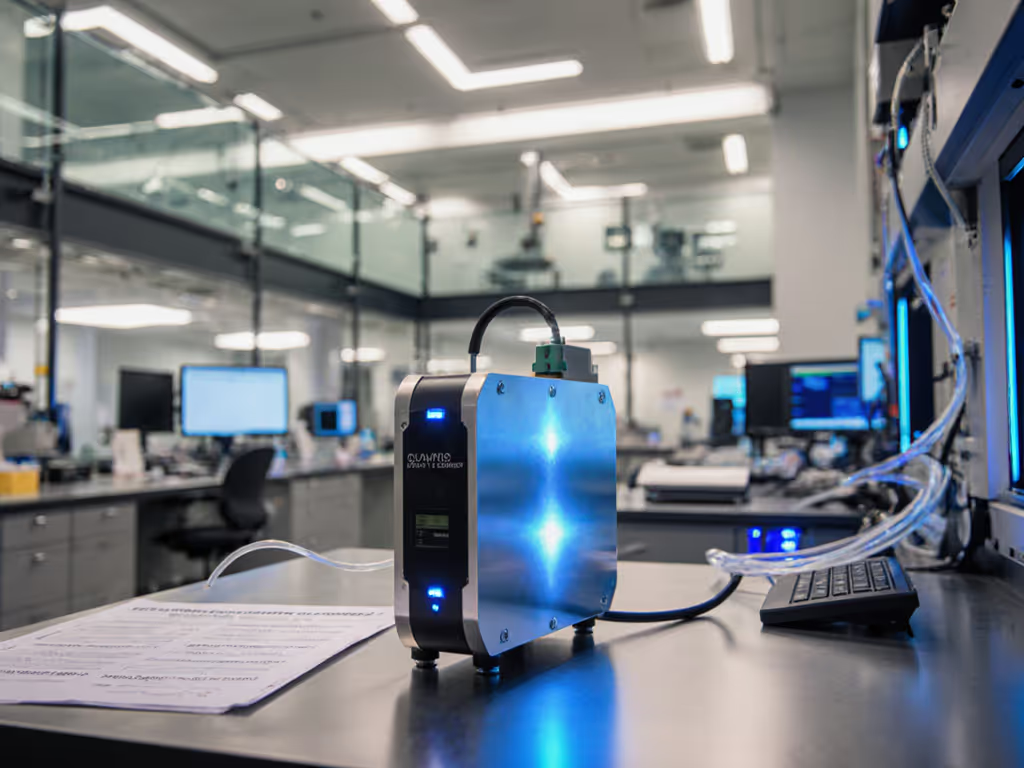
Quantum gravity sensors and mineral exploration metrology are being positioned as the next frontier in subsurface imaging, but before you commit budget to early-stage quantum-based geophysical instruments, you need to run the TCO math and understand where the downtime risk actually sits.
I've spent fifteen years negotiating service coverage and modeling lifecycle costs on exploration and sensing platforms. The pitch for quantum sensors is compelling: higher sensitivity, fewer stations, faster surveys, lower environmental footprint. The reality is messier. You're evaluating hardware that's still maturing in production, calibration services that are nascent, and lead times that can ambush a project. The difference between a breakthrough and a three-week standstill comes down to whether you've locked in a spares strategy and vendor support before something fails on a remote site.
Here's how to cut through the marketing and ask the questions that matter.
1. Understand What You're Actually Buying
Quantum gravity sensors don't replace traditional gravimetry, they augment it. Gravimetry measurement tools like classical borehole and airborne gravity meters measure the local gravitational field to infer subsurface density. Quantum sensors use atom interferometry or cold-atom traps to measure gravitational gradients (how gravity changes over distance) with much higher precision and less sensitivity to environmental noise.
The promise: you need fewer survey stations, get faster coverage, and reduce the logistics footprint. You can detect density contrasts down to a few parts per billion, which theoretically lets you see mineral bodies, ore shoots, and structural geometry more clearly than classical gravity alone.
The catch: these instruments are still lab-grade equipment being adapted for field deployment. Cold-atom gravimeters require laser systems, vacuum chambers, control electronics, and power budgets that dwarf older sensors. Portability is relative. Ease of use is not yet a default.
2. Assess the Maturity & Supply Risk
A handful of vendors are bringing quantum sensors toward production readiness. Nomad Atomics is developing compact cold-atom gravimeters and accelerometers with drift-free, stable measurements designed for exploration. DeteQt is manufacturing diamond-on-chip quantum magnetometers that can be deployed at scale. SBQuantum combines quantum magnetometry with drone-based platforms for rapid mineral discovery. Fleet Space is integrating muon tomography, quantum gravimeters, and AI modeling into joint-inversion frameworks for 3D subsurface imaging.
None of these are household names in classical geophysics. Most are startups or specialized research-to-market operations. That means:
- Lead times are unpredictable. You're not ordering from a decades-old supply chain; you're waiting on bespoke assembly and calibration.
- Service networks are thin. If your quantum gravimeter stops working in the field, you may not have a 24-hour parts drop or a loaner unit standing by, unlike the experience with classical instruments from established vendors.
- Calibration and maintenance protocols are still being standardized. There's no universal service agreement template; you'll be negotiating custom terms on every deal. For when to outsource and how it impacts uptime, see our calibration services market guide.
I learned this the hard way with an early-stage imaging probe. The unit cost was 30% cheaper than the incumbent, and the specs looked superior. But when the detector drifted out of calibration after six weeks, the nearest service tech was three weeks away. We sat idle while a three-month exploration window closed. The bargain cost us 12 times its price in lost survey data and delayed drilling decisions. We switched vendors and locked in a service agreement that guaranteed a loaner within 24 hours if primary hardware failed. That's when the actual cost became clear.
Before you commit to quantum sensor hardware, demand:
- Confirmed lead times with penalty clauses.
- Named backup suppliers or loaners available within your operational zone.
- Written calibration intervals and confirmed cost-per-calibration cycle.
- Availability of replacement modules, lasers, and control boards for at least five years.
- On-site or near-site service capacity, or a shipping protocol that doesn't exceed your survey season.
3. Model the True Cost of Ownership
The headline cost of a quantum gravimeter may be $200K-$500K depending on configuration. But TCO math includes far more.
Hardware amortization: Capital cost divided by expected useful life (typically 5-7 years for field instruments). But if your quantum sensor spends 30% of its life in the service depot or waiting for parts, you're paying for dead time.
Calibration and verification: Quantum sensors require periodic recalibration using reference standards. Traditional gravimeters drift predictably; quantum sensors are marketed as "drift-free," but that claim needs validation in your actual field environment (temperature, vibration, magnetic interference). Budget $10K-$30K per annual calibration, plus shipping and downtime.
Training and technique: Cold-atom systems are not point-and-shoot. Your crew needs formal training on laser alignment, vacuum integrity, control software, and data QA. One bad operator setup ruins a survey line. Factor in $20K-$50K for initial and refresher training, plus time lost to skill-building.
Accessories and consumables: Replacement laser tubes, vacuum pump oil, calibration references, data-logging hardware, and drone integration kits add up. Quantum magnetometers using diamond sensors require ongoing material costs. Classical gravity can limp along with minimal consumables; quantum systems are less forgiving.
Integration and software: If you're fusing quantum gravity with muon tomography, seismic, and classical gravity inside a joint-inversion AI framework, you need licensed software, data processing compute, and IT support. That's an additional $50K-$200K per project cycle, depending on scale.
Contingency for downtime: This is the line item most teams skip. Downtime is a line item. See our fixed vs portable TCO guide to pressure-test downtime assumptions and service costs. If your critical survey window is June to August and your quantum sensor fails in July with no loaner and a 3-week repair turnaround, you've lost revenue and pushed your drilling timeline by a season. Quantify this risk: what's the cost of a one-month survey delay to your mineral discovery roadmap?
A realistic TCO for a quantum gravity sensor deployment across a two-year exploration program can be $800K-$1.5M once you include hardware, calibration, training, software, integration, and contingency. Classical gravity with proven vendors and established service networks might deliver comparable coverage for $400K-$700K. The question is whether the precision gain and reduced station count justify the premium and the immature supply risk.
4. Evaluate Real-World Field Performance
Laboratory specs don't translate cleanly to remote field sites. Quantum sensors achieve high sensitivity by exploiting quantum properties in precisely controlled environments. In the field, you face:
- Temperature drift: Classical gravimeters are sensitive to temperature; so are quantum sensors. But quantum sensors use laser wavelengths and atomic resonances that require tight thermal control. Field tents and diurnal swings can degrade accuracy if your cold-atom trap drifts.
- Vibration and seismic noise: Quantum gravity gradiometers measure tiny differences in gravitational force over short distances, making them vulnerable to ground vibration. A nearby bulldozer, passing truck, or wind gust can corrupt a measurement. Your survey crew needs to manage measurement windows and environmental logging.
- Power and logistics: A classical gravimeter sips battery power. A quantum system with lasers, vacuum pumps, and control electronics may demand 500W-2kW continuous, requiring solar arrays, generators, or frequent battery swaps. In remote terrain, that's a logistics overhead classical crews don't face.
- Data quality variability: Early field trials report detection of subsurface features (tunnels, density anomalies) with sub-meter spatial resolution. But repeatability across different operators, weather conditions, and equipment configurations is still being established. You're partly funding R&D, not purely buying production-ready capability.
Recent deployments show promise: quantum sensors have detected 2-meter tunnels with sub-meter precision and have been successfully deployed in 50-meter boreholes. Drone-mounted quantum magnetometers are being operationalized for airborne surveys. But maturity is still uneven. You'll be an early-adopter, not a follow-the-leader.
5. Compare Quantum vs. Conventional + Supplementary Methods
One benchmark: can you achieve similar subsurface imaging by combining classical gravimetry with cheaper supplementary tools (seismic, magnetics, resistivity) rather than investing in quantum sensors?
Classical gravity + seismic has a 50-year track record. You know the noise floor, calibration protocols, and integration workflows. Cost per survey: $300K-$600K for a regional program.
Quantum gravity + AI joint-inversion promises faster iteration, higher precision, and lower environmental footprint. Cost per survey: $800K-$1.5M including software and integration. You're paying a premium for speed and reduced station count, which matters if your exploration calendar is tight.
The hybrid play: Start with classical gravity and strategic magnetics at known prospects. If the inversion ambiguity is large and you're looking at deep, subtle targets, add quantum-enhanced gravity or muon tomography as a targeted second phase, rather than deploying quantum sensors across the entire regional survey. This reduces your upfront capital commitment and spreads the technology adoption risk over multiple decision points.
6. Scrutinize Service & Support Terms
This is non-negotiable. Before you sign a purchase order, lock in:
- Calibration SLA: Guaranteed turnaround (e.g., 5 business days, door-to-door) with agreed cost. Ask for data on actual turnaround over the past 12 months; startups often underestimate logistics friction.
- Loaner policy: If your unit fails under warranty, does the vendor provide a loaner or credit for downtime? Stipulate this in writing.
- Spare parts availability: Identify the longest-lead-time components (lasers, control boards, vacuum components) and confirm they're stocked for at least 3 years. Ask for a spare-parts kit to keep on-site.
- Software updates and obsolescence: Quantum sensor software is evolving. Will the vendor commit to backward compatibility? What's the lifecycle for control firmware? Are updates free or subscription-based?
- Training and documentation: Request full system documentation, troubleshooting guides, and video tutorials. Insist on on-site or remote training before the instrument leaves the factory.
- Warranty scope: Is it parts-and-labor, or labor-only? Quantum sensors can fail in non-obvious ways (laser alignment, vacuum degradation). Clarify what's covered.
7. Check Integration Readiness with Your Data Workflow
A quantum sensor is only valuable if its data flows cleanly into your subsurface modeling and AI platform. Ask:
- Data format compatibility: Does the sensor output standard formats (HDF5, NetCDF, ASCII) or proprietary binary that requires custom parsing?
- Real-time QA: Can you flag bad measurements in the field, or do you learn about data quality back in the office after the survey is done?
- Software stack: If you're using Seismic Exchange, Geosoft, or proprietary inversion code, confirm that quantum data integrates without custom middleware.
- API and scripting: Can you automate data ingestion and preprocessing, or do you need manual steps?
Fleet Space's joint-inversion framework integrates quantum gravimeters, muon tomography, seismic, and classical gravity, which is compelling. But that's a full software ecosystem; it's not a plug-and-play add-on to your existing workflows. Factor in 4-8 weeks of integration and validation before your first production survey. If you're planning predictive QA or automated decisioning, review our AI in metrology guide for integration pitfalls and data quality tips.
8. Reality-Check the ROI Against Your Exploration Stage
Early-stage exploration (grassroots regional reconnaissance) has loose tolerance on subsurface ambiguity and a long timeline. Quantum sensors may be overkill for a $2M regional survey that feeds 5-10 drilling targets over 2 years.
Advanced-stage exploration (definition drilling, pre-development) has tight tolerance on target geometry and ore-body orientation. Quantum sensors can pay off here: sub-meter precision gravity mapping ahead of infill drilling reduces drill program costs and accelerates resource estimation. If each borehole costs $200K and you can use quantum gravity to eliminate one or two holes per prospect, you've recouped the sensor investment. For a simple framework to quantify savings, use our metrology ROI guide.
For Kincora Copper's deployment of Atomionics quantum gravity alongside AI modeling at the Cowal East project, the ROI hinges on whether the quantum data accelerates mine development decisions and reduces exploration drilling. Early results from industry pilots suggest time-to-drill-ready targets shortens by 20-30%, which can justify the technology premium in advanced-stage work.
Your question: At what exploration stage does quantum sensor ROI turn positive? For most companies, it's after classical geophysics has defined drill targets but before phase 2 infill drilling. Earlier, you're funding research. Later, you've already committed to drilling anyway.
9. Standardization and Future-Proofing
Quantum sensors are still balkanized: different vendors use different atomic species (rubidium, cesium, strontium), different trap geometries (MOT, fountain, cavity), and incompatible readout schemes. There's no universal standard for field-deployable quantum gravimeters the way there is for classical gravity meters (e.g., Worden or Bodenseewerk gravimeters, calibrated against IGRF reference curves).
This means:
- Data comparability: A survey done with Nomad Atomics gravimeters and a follow-up survey done with DeteQt magnetometers may not integrate seamlessly without custom calibration steps.
- Vendor lock-in: Once you commit to one vendor's hardware and software stack, switching costs are high. You've trained crews on their system, integrated their data format, and built survey protocols around their instrument.
- Obsolescence risk: If your chosen vendor pivots, is acquired, or goes bankrupt (not uncommon for deep-tech startups), you're left with unsupported hardware and no path to upgrades.
Mitigate by:
- Insisting on open data formats and API documentation.
- Negotiating source-code escrow or long-term support agreements.
- Diversifying: use quantum sensors for high-value prospects but maintain classical geophysics capability as a fallback.
- Monitoring the landscape: Nomad Atomics, DeteQt, SBQuantum, and Atomionics are all well-funded, but the sector is young. Track who's hiring, publishing, and signing corporate partnerships.
10. Final Verdict: When Quantum Sensors Make Business Sense
Adopt quantum gravity sensors if:
- You're in an advanced-stage exploration program with a compressed timeline (12-24 months to drill-ready targets) and classical geophysics is creating ambiguity that would require an extra round of drilling or geotechnical work to resolve.
- Your cost per borehole exceeds $150K-$200K, and quantum-guided targeting can save one or more holes per prospect.
- You have a long-term geophysical program (5+ years) that can amortize technology learning curves and integrate quantum data across multiple projects.
- Your exploration acreage or concessions have complex geology (deep targets, subtle density contrasts, high overburden) where classical gravity resolution breaks down.
- Your team has in-house geophysics expertise to manage integration, QA, and inversion workflows; you're not outsourcing the entire survey.
- You can negotiate service terms that guarantee loaner units, 5-day calibration turnaround, and on-site spares, and you're willing to pay 15-25% premium for de-risked operations.
Defer quantum sensor investment if:
- You're in grassroots or early-stage exploration where the survey informs a long-term play and time-to-drilling is 2+ years. Classical geophysics is cheaper and sufficient.
- Your per-borehole cost is under $100K, or your prospect base is small. The quantum premium doesn't pencil.
- You lack in-house geophysics capability and would rely entirely on contractors. That outsources your learning curve and deepens vendor dependency.
- Your exploration timeline is fixed and short (one season). Quantum sensor ramp-up, calibration lag, and integration friction will stress your schedule.
- Your budget for geophysical support is tight. Quantum technology is capital-intensive and cost-escalation risk is high because supply chains are immature.
Pay for capability, not chrome. Count the lifecycle costs. Quantum gravity sensors are not yet a default choice; they're a surgical tool for specific, high-value applications where the precision gain and time-to-decision acceleration offset the capital cost, integration burden, and support risk. The vendors are moving fast, and by 2027-2028, maturity will improve. But today, you're still taking on adoption risk that deserves explicit quantification in your business case.
Fusion of quantum gravimetry, quantum magnetometry, muon tomography, and AI-driven inversion is genuinely powerful. Just ensure your downtime coverage, spare-parts strategy, and vendor support are locked in before you fly that first survey line. That's how you turn an exciting technology into a repeatable, confidence-building capability.
Related Articles