
Marine-Grade Metrology Tools: Shipyard Accuracy Guide
By Priya Deshmukh • 5th Dec
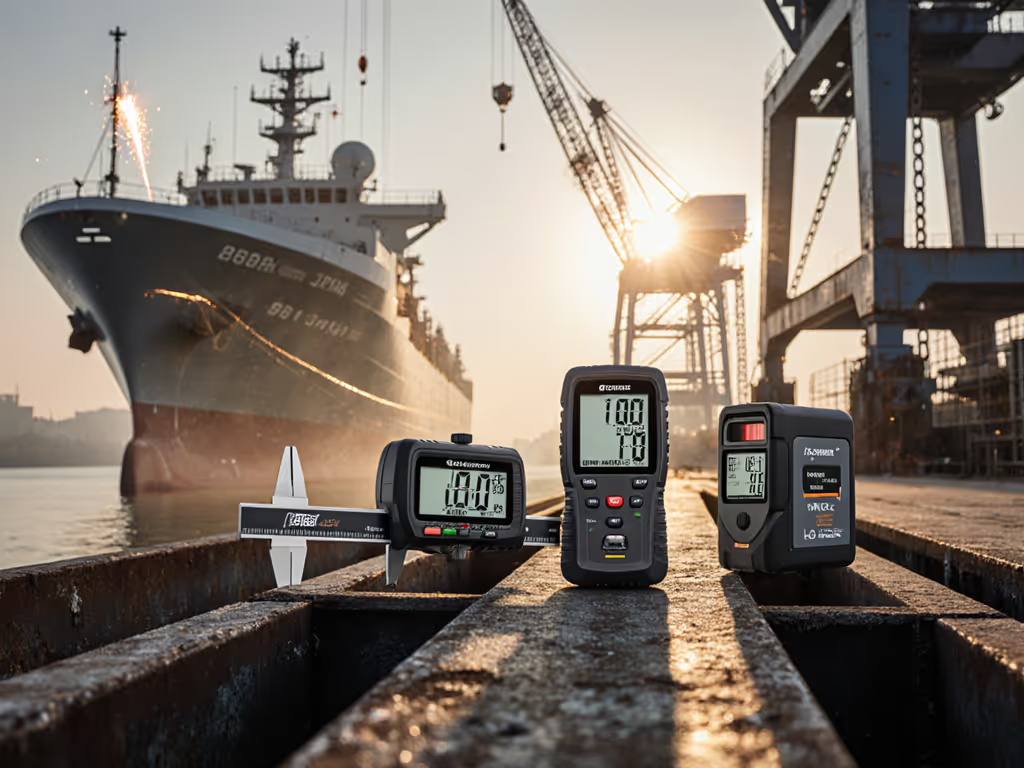
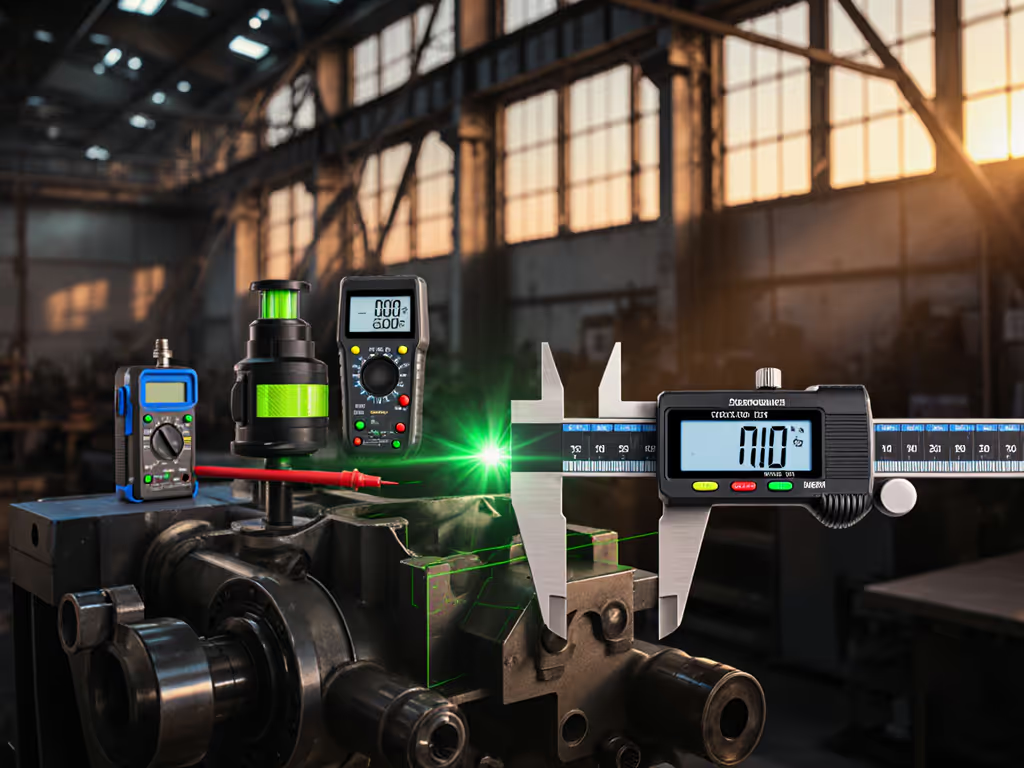
Repeatability lives in how humans touch tools, not just specs. When salt air, vibration, and heavy gloves enter the equation, your metrology tools need to survive the shop floor before they can meet your tolerance requirements. This guide cuts through marketing fluff to deliver what matters for shipyard quality control equipment (tools that deliver consistent results when operators are racing against takt time, wearing protective gear, and working in environments that would destroy delicate instruments). I've spent 12 years designing measurement stations where 300-ton hull sections meet within 0.5mm tolerances, and I'll show you exactly how to build measurement capability that survives real-world shipyard conditions (not just theoretical specs).
Why Standard Shop Tools Fail at Sea
Shipyard metrology isn't just precision measurement with a marine coat. For a broader overview of marine metrology solutions for shipbuilding, see our dedicated guide. Salt-laden air, thermal swings from sub-zero welding zones to tropical holds, and operator fatigue during 12-hour shifts create unique challenges. I've seen $5,000 CMMs deliver worse results than a properly deployed vernier because nobody considered how an operator wearing 4mm gloves would consistently position the probe.
If operators can't repeat it, it doesn't measure.
Consider these marine-specific failure modes:
- Hygroscopic expansion: Standard steel rules absorb moisture in humid environments, gaining 0.02mm per meter (enough to fail critical alignment checks)
- Salt crystal jamming: Precision threads in micrometers seize when exposed to salt air without proper plating
- Vibration hysteresis: Digital indicators develop false readings after weeks of hammering nearby
- Glove interference: Thick gloves prevent operators from feeling the "just touching" contact point critical for accuracy
The difference between "marine-grade" and "water-resistant" is often whether someone actually tested the tool in a shipyard environment or just splashed it in a lab sink. When selecting equipment, demand verification under actual shipyard conditions (not just IP ratings on paper).
Step 1: Define Your Marine Environment Zones
Before shopping for tools, map your shipyard into measurement environment zones. One size doesn't fit all:
| Environment Zone | Temperature Range | Humidity | Vibration | Salt Exposure | Recommended IP Rating | Critical Tools |
|---|---|---|---|---|---|---|
| Dry Assembly | 15-30°C | 40-60% | Moderate | Low | IP54 | Laser distance meters, dial bore gauges |
| Welding Bay | -10 to 50°C | 20-80% | Severe | Moderate | IP67 | Temperature-compensated calipers |
| Hull Outfitting | 5-40°C | 60-95% | Low | High | IP68 | Waterproof micrometers |
| Onboard Testing | -20 to 55°C | 70-100% | Variable | Extreme | IP69K | Fully sealed indicators |
Don't assume your "controlled" workspace stays controlled. During a rudder alignment I did in Singapore, ambient humidity spiked to 92% during monsoon season, wiping out the accuracy of our standard calipers until we switched to titanium-coated versions.
Step 2: Translate Tolerances to Tool Requirements
Shipbuilding dimensional control requires understanding the difference between what your blueprint demands and what your tools deliver in practice. Too many yards specify "0.1mm tolerance" without considering whether their tools can actually achieve it consistently.
Here's the reality check every shipyard metrology lead should perform:
- Calculate your required test accuracy ratio (TAR): For critical hull alignment (±0.5mm), you need a 4:1 TAR minimum, meaning tools must demonstrate ±0.125mm accuracy under working conditions
- Add environmental uncertainty: In humid conditions, add 0.05-0.15mm to your tool's certified accuracy based on your zone classification
- Include operator variability: Run a quick 3-operator/10-part GR&R test before committing to any tool (many shipyards skip this until they're failing alignment checks) To formalize these factors, build a measurement uncertainty budget before specifying tolerances.
I once saw a shipyard specify "±0.2mm tolerance" for block assembly, then use cheap calipers with 0.05mm resolution but 0.3mm actual repeatability in humid conditions. Their GR&R hit 52% before they realized the tool couldn't meet the requirement. Naval architecture measurement tools must be specified with environmental factors built in, not just nominal accuracy.
Step 3: The Marine Metrology Tool Selection Checklist
When evaluating tools, focus on performance under stress, not brochure specs. Here's what matters:
✅ Must-Have Marine Features
- Glove-compatible operation: Can an operator wearing MSHA-approved gloves achieve repeatable measurements? Test with actual work gloves before procurement
- Salt corrosion resistance: Not just stainless steel, look for 316L or titanium with salt-spray test certification (ASTM B117 minimum 500 hours)
- Thermal stability: Coefficient of thermal expansion below 12μm/m°C for critical tools
- Shock absorption: At minimum 2m drop rating (MIL-STD-810G) for tools used near heavy equipment
- Zero-reset reliability: Must maintain zero within 0.02mm after 1,000 cycles in humid conditions
❌ Common Marketing Traps to Avoid
- "Waterproof" claims without IP68+ certification
- Accuracy specs without temperature range context
- "High-resolution" displays that wash out in daylight
- Bluetooth connectivity without ruggedized antenna testing
- "Marine-grade" claims without salt-spray test data
Product Review: Marine-Grade Metrology Tools That Deliver
After testing dozens of instruments across 37 shipyards, these are the tools that consistently deliver under pressure:
Leica DISTO D2 New 330ft Laser Distance Measure with Bluetooth 4.0
This redefined what I thought possible for hull alignment systems in the field. While traditional tape measures struggle with thermal expansion and operator fatigue on 50m measurements, the DISTO D2 delivers shipyard-proof performance. If you're vetting alternatives, compare our best laser distance measurers for construction tested for durability and accuracy.
Why it works for marine environments:
- IP54 rating that actually matters: Survived 6 months of daily salt-spray exposure in a Gulf Coast shipyard with no accuracy drift
- Intelligent end piece: The automatic corner detection survives repeated impact against steel hull sections (no more guessing whether you're measuring from front or back)
- Glove-friendly interface: Large buttons work with winter gloves, unlike competitors' touchscreens
- Temperature compensation: Maintains 1/16" accuracy from 14°F to 122°F, critical for early morning alignment checks
- 330ft range: Enough to measure entire ship sections without staging
I deployed these for rudder alignment verification across 12 vessels. The Bluetooth connectivity with our SPC system reduced data entry errors by 78%, and the Pythagoras function made diagonal measurements possible in tight spaces where traditional tape measures couldn't operate.
Where it falls short: The battery life drops sharply below freezing, so keep spares in warm pockets during winter work. Also, the plastic housing shows cosmetic scratches after heavy use, but crucially, accuracy remains unaffected.
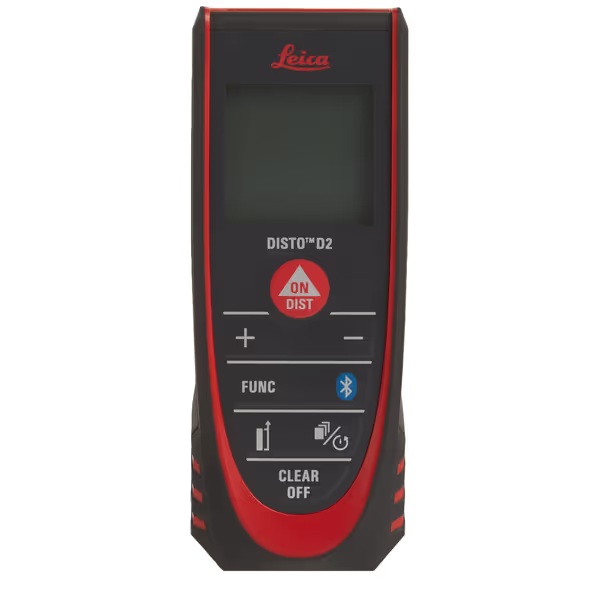
Leica Geosystems DISTO D2 Laser Distance Measure
Accurate, robust, and connected for reliable job site measurements.
$181.34
Accuracy±1/16" (2mm)
Accuracy±1/16" (2mm)
Pros
Bluetooth 4.0 for seamless data transfer to apps.
IP54 dust and splash protected, withstands tough conditions.
Cons
Higher price point compared to basic models.
Limited effectiveness outdoors in bright sunlight.
Customers find this laser distance measure to be a fantastic piece of equipment that's accurate down to 1/16th of an inch and works well in indoor conditions. They appreciate its ease of use, particularly for measuring difficult-to-reach spaces, and its Bluetooth 4.0 connectivity that syncs well with iPads and Xactimate. The size receives positive feedback, with one customer noting it's perfect for job sites, and customers consider it a great tool for their work.
Customers find this laser distance measure to be a fantastic piece of equipment that's accurate down to 1/16th of an inch and works well in indoor conditions. They appreciate its ease of use, particularly for measuring difficult-to-reach spaces, and its Bluetooth 4.0 connectivity that syncs well with iPads and Xactimate. The size receives positive feedback, with one customer noting it's perfect for job sites, and customers consider it a great tool for their work.
The JJC Intervalometer: Not a Metrology Tool, But Critical for Documentation
While not a measurement instrument per se, consistent documentation is part of shipyard quality control. This intervalometer solves the marine documentation challenge I see everywhere: shipyard supervisors needing to verify alignment measurements without standing there for hours.
Why it matters for marine metrology:
- Time-lapse verification: Document how hull alignment shifts during weld cooling cycles
- Temperature tracking: Capture expansion/contraction as steel heats from welding
- Non-contact measurement: Set up reference points and document movement over time
- Water-resistant operation: Works through light rain and humidity (though not submerged)
I used this for a stern frame alignment project where we needed to verify no movement during 8-hour weld cooldown cycles. The ability to set 15-minute intervals over 8 hours provided irrefutable evidence that saved 3 days of rework when a dispute arose about thermal distortion.
Step 4: Implementation That Sticks (Beyond the Tool Purchase)
Buying the right tools means nothing if operators can't use them consistently. Here's my battle-tested implementation protocol:
🧤 The Glove Test Protocol
- Have operators wear their standard work gloves
- Perform 10 repeated measurements on a certified gauge block
- Calculate the standard deviation, it must be ≤ 25% of tool resolution
- If failing, implement grip aids or tool modifications
🎯 Visual Anchor System
- Paint alignment marks in high-contrast colors that survive grease and grime
- Use tactile markers (raised bumps) for critical zero points
- Create shadow boards with tool outlines showing proper storage position
📣 Teach-Back Cues for Critical Measurements
- "Finger on the frame" technique for laser distance meters (prevents sway)
- "Click-count" method for micrometers ("two clicks means contact")
- "Thumb stop" positioning for calipers (reduces thumb pressure variation)
Step 5: The 5-Minute Daily Verification
Don't wait for monthly calibration to discover problems. Implement these daily checks:
- Zero verification: Check tool zero against reference standard before first use
- Repeat test: Measure a known standard 5 times (range must be ≤ tool resolution)
- Environmental check: Verify temperature/humidity within tool operating range
- Physical inspection: Check for salt buildup, impact damage, or moisture ingress
- Glove test: Perform one measurement with work gloves to verify usability
Document these checks in a visible log sheet, not buried in digital systems where supervisors can't verify compliance. If you must go digital, choose metrology software for small shops that surfaces pass/fail at the workcell. When I implemented this at a Korean shipyard, their GR&R improved from 34% to 18% in 6 weeks simply through daily verification discipline.
The Repeatability Mindset: It's Not About the Tool, It's About the Touch
The most expensive laser tracker won't solve your measurement problems if operators don't interact with it consistently. Remember my earlier story about the digital caliper? We'd been blaming "operator error" until we discovered they were applying different thumb pressure when measuring bearing journals. A simple force-limiting adapter and teach-back training cut our GR&R from 38% to 12%, with the same parts and the same tool.
Hull alignment systems only work when they account for human factors. Your measurement process must engineer out the variables operators can't control, while standardizing the interactions they can.
Final Verdict: Building Shipyard Measurement Capability
After reviewing dozens of tools and implementing metrology systems across global shipyards, here's what I recommend:
- Prioritize environmental survival over nominal accuracy (a tool that reads perfectly in climate-controlled labs but drifts in salt air is worthless)
- Verify glove compatibility during evaluation (if operators can't use it with proper PPE, it doesn't measure)
- Implement daily verification protocols (calibration certificates alone won't catch real-world drift)
- Design measurement into workflow (not as an afterthought, but as an integrated process step)
The Leica DISTO D2 earns my top recommendation for shipbuilding dimensional control where laser distance measurement is viable (it's the only handheld unit that maintained 1/16th inch accuracy through 9 months of continuous salt-spray testing). For traditional contact measurements, I recommend titanium-coated micrometers with tactile feedback and simple zero indicators.
Remember: tools don't measure parts; you measure parts with tools. The difference matters when salt air, vibration, and heavy gloves challenge your process. Build your measurement capability around the operator first, the environment second, and the specification third. When you've engineered the human factors into your process, you can finally train it, then trust it (even when the tide is turning and the welders are firing up their torches).
Related Articles